Novel Bio-Based Polyols for Flame Retardant Polyurethane Sealants

A sealant is an elastomeric material that allows for 25% to 50% movement. They are used to level, fill gaps, seal holes and provide bonding and protection. Sealants are made by using either silicone or polyurethane.

Polyurethane sealants are formed by reacting an isocyanate component with amines, polyols or other active hydrogen compounds. Some polyurethane sealants are flame retardant where flame retardants such as ammonium polyphosphate are used along with the polymers to obtain the desired character. So far, only specialty polyols polyurethane-joint-sealantlike polycarbonate polyols, polycaprolactone polyols, polybutadiene polyols, and polysulfide polyols have been used to make polyurethane sealants.

Now, Chinese researchers have developed a novel ricinoleic acid based phosphorus and nitrogen-containing flame retardant polyols (FRPE) for polyurethane sealants. The flame retardant polyols were characterized by different characterization techniques.

Flame retardant polyurethane sealants (FR-PUS) were prepared by curing flame retardant polyols with methylene diphenyl diisocyanate (MDI-50). The flame retardant properties of the polyurethane sealants were investigated using limiting oxygen index (LOI), cone calorimeter testing (CCT) and thermogravimetric analysis (TGA).

Results showed that flame retardant polyols could enhance the thermal stability and flame retardancy of polyurethane sealants without adding any other flame retardant.

Now, industries manufacturing polyurethane sealants could produce them in a renewable way which will be environmental friendly.
Source

Sebacic Acid – Unique, Bio-Based Feedstock for Green Polymers: Overview of Interview with Roland Glotzer

Sebacic_acid_3D_ballBio based polymers are those derived from renewable resources and appear to be more environmental friendly than polymers derived from petroleum. Due to their ecological benefits, the production and consumption of biobased polymers are increasing.
Bio based polyamide, also called nylon, is one of the oldest bio based engineering plastics. Most of them are currently derived from castor oil. The key ingredient for the manufacture of bio based polyamide is Sebacic acid derived from castor oil.

In 2012, Arkema acquired Casda Biomaterials, the earliest manufacturer of Sebacic acid in China. Roland Glotzer, who previously headed Arkema Chemicals took control as the CEO of Casda Biomaterials in August 2014.

A 2015 interview with Roland Glotzer gives us an overview of Sebacic acid market.

Some of the key highlights from the interview are discussed below:

  1. Bio based polymers made from Sebacic acid have advantages like excellent flexibility, durability, hydrophobicity and lower melting temperatures.
  2. Sebacic acid currently sells in the range USD 3550 to USD 3700 per ton FOB China, while caprolactam, another raw material for polyamide from petroleum costs around USD 2700 per ton. That is, Sebacic acid based polyamides are costlier. But these Sebacic acid based polyamides could offer better physical and chemical properties such as better flexibility and hydrophobicity. Hence the selection of Sebacic acid as feedstock is based on its performance rather than its cost.
  3. Sebacic acid is widely used in plasticizers where sebacates i.e. esters of Sebacic acid are mainly involved in their manufacture. This is due to the superior low temperature resistance of sebacates compared to phthalate plasticizers. Dibutyl sebacate is widely used in food packaging, while Dimethyl sebacate is used in light stabilizers for cellulose resins, synthetic resins and rubbers.
  4. The current markets for Sebacic acid are in the production of various polymers, esters, as a corrosion inhibitor, as an additive for low temperature lubricants, as a buffering agent in cosmetics.
  5. The future of Sebacic acid and its derivatives market is high. However, the industry also requires sustainable financial results. The key factor is the cost of castor oil. We hope that castor oil would continue to be available in prices affordable by all in the supply chain while also ensuring that Sebacic acid would continue to be cost competitive against other possible substitutes.

Source

Castor Seed Prices in 2015 – An Analysis by CastorOil.in

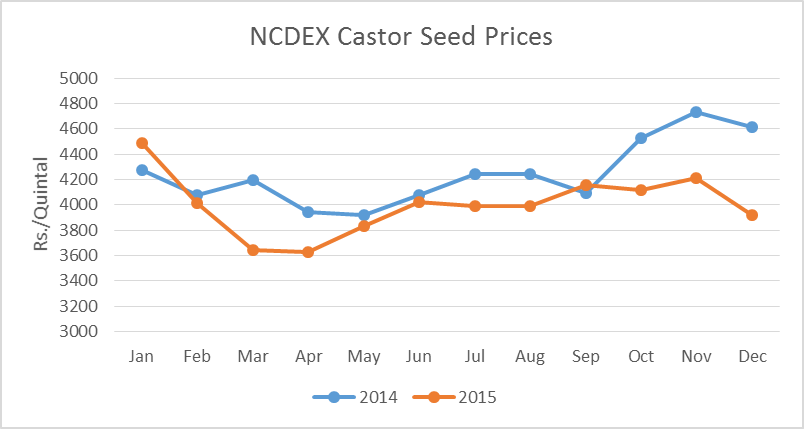
Castor seed prices have traded in the range of Rs. 3600 – Rs. 4200/quintal in 2015. The prices have remained range-bound till October due to a comfortable supply situation. The week rupee and lower prices led to healthy demand and hence the seed prices increased to Rs. 4200/quintal in November, tracking good export demand to China and EU in the latter half of the year.

Prices have increased to Rs. 4215/quintal in November, compared to seasonal low of Rs. 3500/quintal in February 2015. It is expected that the prices will trade in the range of Rs. 4000 – Rs. 4300/quintal before the new crop arrivals pick up in February 2016. (Read more from here)

The average prices for each month are presented below.

2015 2014
Month Rs./Quintal Month Rs./Quintal
Jan 2015 4486.6 Jan 2014 4275.6
Feb 2015 4013.5 Feb 2014 4079.4
Mar 2015 3646.8 Mar 2014 4193.3
Apr 2015 3631.3 Apr 2014 3947.7
May 2015 3830.6 May 2014 3916.6
Jun 2015 4021.8 Jun 2014 4078
July 2015 3991.1 Jul 2014 4241.7
Aug 2015 3992.6 Aug 2014 4247.7
Sep 2015 4160.1 Sep 2014 4096
Oct 2015 4115.3 Oct 2014 4527.8
Nov 2015 4215.2 Nov 2014 4731.3
Dec 2015 3920.8 Dec 2014 4612


NCDEX castor seed prices

Yearly average prices:

2014 – Rs.4245/quintal

2015 – Rs.4002.1/quintal

Some observations:

  • Starting with a high of Rs 4500/quintal, the lowest price reached during the year (about Rs 3600/quintal) is almost 20% lower than the highest price during the year.
  • Even though the price almost touched Rs 3600/quintal during 2015, we can see that it has remained almost at or above Rs 4000/quintal for most of the months (9/12 months, it has been Rs 3900 and above), so one can say that Rs 40/Kg (and for a few months above 40) was the dominant price of castor seeds during 2015.
  • In 2014, though the prices have started off at a price lower than 2015, the price trend has remained somewhat stable during February to June compared to 2015. During the end of the year, in the months of Oct to Dec, the prices have reached very high compared to 2015.  The prices have been above Rs.40/kg except for two months.
  • When we compare the yearly average prices, the average price for 2014 is Rs.4245/quintal, while that for 2015 is Rs.4002.1/quintal which shows a 5.7% reduction in price in 2015.

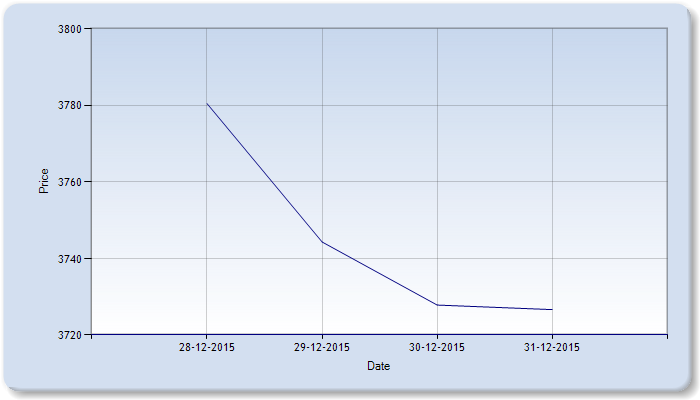
Castor Seed Price Weekly Report: Dec 28 – 31, 2015

CastorOil.in brings you the weekly report of castor seed price at NCDEX.

Check out the table and the graphical data.

The closing price for last week was Rs. 3770/quintal. This week, a decrease in price of castor seed was observed throughout the week.

In general, a gradual decrease in the price of castor seed was observed compared to previous week.

Price Date Rs. Per Quintal
28 Dec 3780.4
29 Dec 3744.3
30 Dec 3727.85
31 Dec 3726.65

Castor Seed Price Weekly Report: Dec 28 – 31, 2015

Source

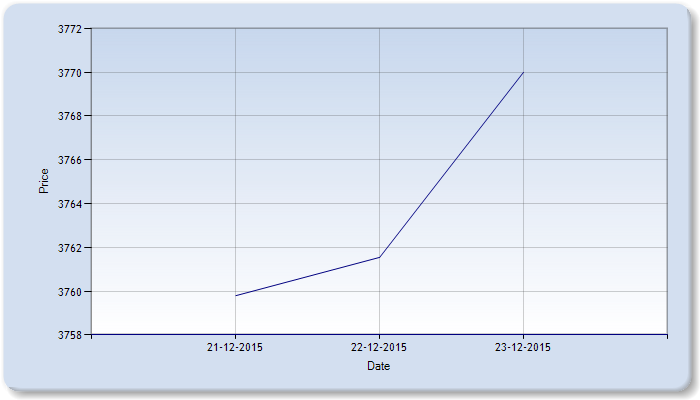
Castor Seed Price Weekly Report: Dec 21 – 24, 2015

CastorOil.in brings you the weekly report of castor seed price at NCDEX.

Check out the table and the graphical data.

The closing price for last week was Rs. 3817/quintal. This week, an increase in price of castor seed was observed throughout the week.

In general, a decrease in the price of castor seed was observed compared to previous week.

Price Date Rs. Per Quintal
21 Dec 3759.8
22 Dec 3761.55
23 Dec 3770

Castor Seed Price Weekly Report: Dec 21 – 24, 2015

Source

Castor Seed Price Weekly Report: Dec 14 – 18, 2015

CastorOil.in brings you the weekly report of castor seed price at NCDEX.

Check out the table and the graphical data.

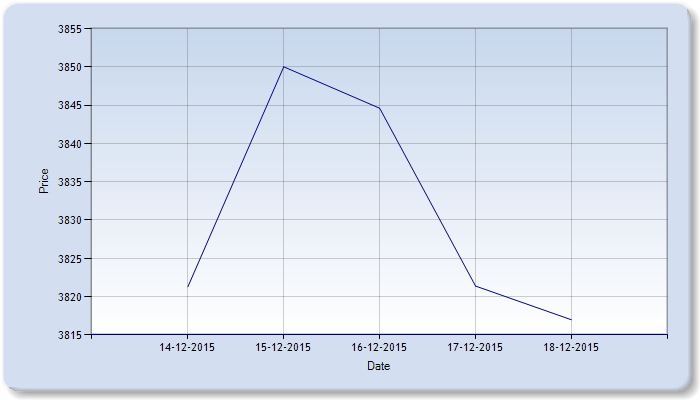
A decrease in price of castor seed was observed at the end of the week.

Price Date Rupees Per Quintal
14 Dec 3821.3
15 Dec 3850
16 Dec 3844.6
17 Dec 3821.4
18 Dec 3817

Castor Seed Price Weekly Report: Dec 14 – 18, 2015

Source

Castor Seed Price Weekly Report: Dec 07 – 11, 2015

CastorOil.in brings you the weekly report of castor seed price at NCDEX.

Check out the table and the graphical data.

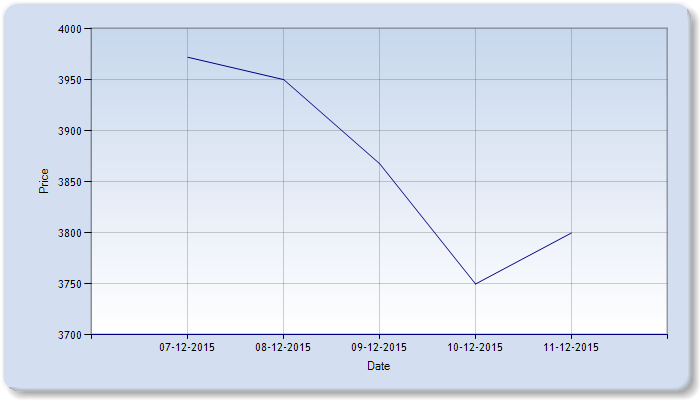
A decrease in price of castor seed was observed at the end of the week.

Price Date Rupees Per Quintal
07 Dec 3971.9
08 Dec 3950
09 Dec 3867.7
10 Dec 3750
11 Dec 3800

Castor Seed Price Weekly Report: Dec 07 – 11, 2015

Source

New Disease-resistant Castor Seeds to be Released Soon

Scientists at zonal agricultural and horticultural research station of the University castor seedsat Hiriyur have developed a disease resistant and high yield variety of castor seed called HCH-6 (Hybrid Castor Hiriyur) which is a fusion of DPC-9 and TMV-6 varieties.
The yield of the variety is said to be around 18 quintals per hectare while it is around 13-14 quintals per hectare in other existing varieties.

Source

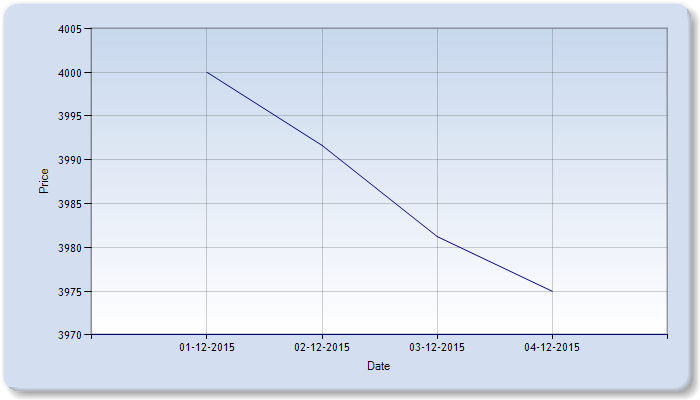
Castor Seed Price Weekly Report: Dec 01 – 04, 2015

CastorOil.in brings you the weekly report of castor seed price at NCDEX.

Check out the table and the graphical data.

A decrease in price of castor seed was observed at the end of the week.

Price Date Rupees Per Quintal
01 Dec 4000
02 Dec 3991.65
03 Dec 3981.25
04 Dec 3975

Castor Seed Price Weekly Report: Dec 01 - 04, 2015

Source

Pure Polyurethane and Castor Oil Based Polyurethane: Synthesis and Characterization

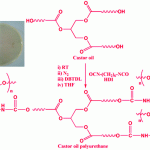
Scientists from Malaysia performed an experiment to compare the physico-chemical properties of high performance polyurethane prepared using pure poly propylene glycol (PPG) and that prepared from PPG and castor oil.castor oil polyurethane

Characterization studies indicated the presence of large -CH stretching in castor oil mixed polyurethane with larger oxidative thermal stability over pure PPG polyurethane. The tensile properties were found to be almost comparable showing that mixed polymers can be used in future to overcome environmental and economic crisis.

Source