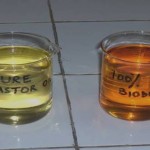
Castor-An Effective Mitigant of GHG Emissions

Castor oil, an universally reputed vegetable oil finds inexhaustible applications in numerous industrial sectors with special references to bio-polymer, lubricant, pharmaceutical and surfactant domains. In the list of vegetable oils for biofuels, castor oil equally reserves its position as a promising source but often its demand in non-energy sector and volatile global market availability has shadowed the contribution of castor to sustainable biofuel development. To circumvent the limitations and harness the carbon credits of castor biodiesel and related environmental advantages, German firm Evogene subjected biodiesel from its high yielding lines of castor to GHG life cycle assessment (LCA).

To best realize the complete environmental impacts of castor biodieel as LCA, Symbiotic Engineering conducted the study in two different locations, USA and Brazil for Evogene’ product. Astonishingly, the results indicated that biodiesel production coupled to use from castor reduced GHG emissions by 90 & 75% in USA and Brazil respectively.

Manufacturers of this biofuel were deeply impressed with energy and ecological weightage of castor and Mr. Assaf Oron, Evogene’s EVP Strategy and Business Development announced that “The results of the LCA strengthen our belief in castor bean”.

For reference:http://advancedbiofuelsusa.info/life-cycle-analysis-of-evogene-castor-bean-based-biodiesel-shows-90-emissions-reduction-compared-to-petroleum

Castor biodiesel run in Ethiopia

The concept of renewable energy has really taken momentum all around the world as the African nation Ethiopia has made moves to initiate ventures on bio-diesel production from castor oil.The prime objective is to reduce the energy burden of the nation since experts  claim that Ethiopia allocates 90% of its foreign revenue to fossil fuel import and hence focus has been applied to exploit the renewable resources for ensuring the sustainability in nation’s economy.

Among the leading Ethiopian energy investors,Global Energy Ethiopia(GEE) has started its operation on renewable energy  since 2007 by pumping US$ 20 million into castor and jatropha seed farming and processing business.According to sources,GEE firm has an opportunity to process 40,000 tonnes of vegetable oil in its investment on concerned bioenergy crops from 30,000 hectares of leased land.Besides GEE, other firms namely Eco Energy has also entered into  bio-energy sector with collaborations from abroad.

According to Ethiopian Investment Agency(EIA),the potential of 25 million hectares of land suited for bio-diesel farming when tapped completely,Ethiopia becomes one of the highest producers of bio-diesel with an estimated capacity of 20 million liters of crude vegetable oil.

Reports such as this are motivating because the nations that have been torn by the economic crisis,civil wars and political instabilities, would have a tremendous scope to lift their socio-economic and environmental consciousness at the competitive International stage.

For reference: http://energybusinessdaily.com/renewables/ethiopia-sets-its-sights-on-biodiesel/

Castor cultivation emerging in Brazil

Castor cultivation extensively is practiced throughout the world for it industrial oil.Recently, Brazilian firm Eco-carbone has made it’s entry into castor venture and claims that the firm has launched a pilot scale production of castor in 1100 hectares of rainfed and irrigated lands hired on rent basis.The anticipated production of castor seed would be around 2300 tonnes per annum.They say that the objective behind this investment is to accelerate the cultivation of castor in Brazil as demand for castor oil and its derivatives are globally increasing.In addition, castor proves to be a viable alternative to Jatropha for the bio-diesel production in Brazil.

It is important to note that Brazil is an excellent agro-climatic zone for the cultivation of castor but its current day production is way behind India.Therefore initiatives of such types would have a deep impact in understanding the potential of this oilseed crop in right geographical zones for economic and employment prosperity.

For further reference:http://www.eco-carbone.com/index.php?Firstlevel_ID=15&lang=en

Plant oil stoves as alternate sources of energy

Bio-fuel from renewable resources has extended its roots to kitchens as well.The German Firms, BSH Bosch and Siemens Hausgeräte GmbH (BSH) have introduced a new plant oil stove “The Protos”. They claim that their eco-friendly stove operates by sustainably generated bio-fuels from castor and other edible oils. It has a great potential to minimize the demand for wood fuels among the rural people.Further, its ecological significance can be best understood by its ability to reduce seven tonnes of carbondioxide emissions per year. After a successful preliminary testing from 2004 to 2006, the firms have sold about 800 plant oil stoves so far in Philippines and plans have been made to evaluate the performance of “The Protos” in other nations including India, Indonesia, South Africa and Tanzania.

Plant oil stoves are extraordinary alternate energy sources for household purposes but needs a complete profile regarding its biosafety, stability to liberate energy and a well defined production technology and volume to feed the stoves to achieve an uninterrupted supply of energy.

For Further Reference:http://www.siemens.com/sustainability/en/sustainable/protos.htm

Castor cultivation for biodiesel production.

Biodiesel from castor is an emerging trend in Jamaica as it planned to use the oil seed crop to minimize its energy burden in a sustainable way.Petrojam Ethanol Limited(PEL) Chairman,Mr.Karl James stated that castor biodiesel is a potential renewable source, well suited to Jamaican conditions and can meet atleast 3% of the total consumption of 168 million gallons of diesel oil demand in the country.He further insisted that the initiative is to be implemented with caution and the formation of inter ministerial committee of Cabinet is mandatory to accelerate the program.Energy Minister, Philip Paulwell said that castor crop is well acclimatized to grow in any marginal region without competing with the principal crops.He also added that castor needs low maintainance and high oil content in beans  renders production effective.

It is vital to carefully select a castor breed and good agronomic practices for the implementation of the project with success.

For further reference:http://jamaica-gleaner.com/gleaner/20070810/business/business1.html

Castor oil as source of biodiesel in Jamaica

An agreement worth US$ 10.3 million has been signed between Petroleum Corporation of Jamaica’s Centre of Excellence for Renewable Energy (PCJ’s CERE) and the Caribbean Agricultural Research and Development Institute (CARDI) to conduct research on Castor and Jatropha for the production of Biodiesel.The proposed research project is  for three years,  from February 2011 to January 2014 and involves an establishment of pilot scale plant to produce biodiesel from castor raised at CARDI and subject the biodiesel for transport oriented applications.The managing director at PCJ Mr:Nigel Logan has said that the partnership would enable the nation to regulate it’s demand for oil and also to explore the native renewable sources for energy production.He further added that optimistic results would guide them to implement the Castor oil biodiesel in transport sector.It is important to remember that Jamaica has already made blends of ethanol with classical fuel which is being sold at energy service stations.

For details, please read:http://www.jis.gov.jm/news/hl.s1/26779

Castor bio-diesel to minimize greenhouse gas emission

Researchers from India have made bio-diesel from Castor oil by alkaline trans-esterification process and assessed it’s physio-chemical properties for locomotive engine based fuel applications.The experimentation with Castor bio-diesel showed promising results for the parameters studied and performed on par with the conventional diesel.They further claimed that by converting 10% of the total production of Castor oil to bio-diesel can minimize the global carbon-dioxide emissions by 79,782 tonnes per annum with zero carbon footprint.

For further reference:http://www.springerlink.com/content/u8535p22463r8377/

Castor biofuel a promising candidate for aviation services

Evogene Ltd, an US based agri-biotech company has announced that castor plant proves to be viable alternate source for the production of biofuel(referred to as biojet) for the aviation services in the future.In a colloborative project work with NASA and Honeywell’s UOP technology, Evogene has made an evaluation of biojet produced from its castor varieties and reports that the oil has satisfied the fuel specifications of  ASTM D7566.It has declared that improved analytical tests will be conducted by NASA and US Air Force Research Laboratory further and points that the fuel from Castor would reduce green house gas emissions by 90% in comparison to fossil fuels.In the Castor Development Programme, the firm has decided to sell its product at US$ 45/Barell in future.

Rheological Behavior of Castor Oil Biodiesel

From the ACS Publications – Energy Fuels, 2005, 19 (5), pp 2185–2188
Abstract
Viscosity, the measurement of the internal flow resistance of a liquid, constitutes an intrinsic property of vegetable oils. It is of remarkable influence in the mechanism of atomization of the fuel spray, in other words, in the operation of the injection system. This property is also reflected in the combustion process, whose efficiency depends the maximum power developed by the engine. This work aims at assessing the rheological behavior of castor oil, castor oil biodiesel, and undegraded and degraded biodiesel at different exposure times and temperatures. Castor oil biodiesel presents viscosity higher than diesel oil, but this drawback can be corrected by means of blends of both components at different proportions. The viscosity data indicated that the heat treatment leads to a degradation of the samples accompanied by an increase of the viscosity, probably because of interactions with intermediary compounds. The degraded samples presented a pseudoplastic behavior, once the flow index, m, is smaller than 1.

Thermoanalytical Characterization of Castor Oil Biodiesel – A Research Project

See details of a project on ”  Thermoanalytical Characterization of Castor Oil Biodiesel” presented at ScienceDirect in Nov 2005

By: Marta M. Conceição, Roberlúcia A. Candeia, Fernando C. Silva, Aline F. Bezerra, Valter J. Fernandes, Jr. and Antonio G.Souza
Abstract
The castor oil seed has 47–49% of oil. Biodiesel obtained from castor oil has a lower cost compared to the ones obtained from other oils, as due its solvability in alcohol transesterification occurs without heating. The use of biodiesel will allow a reduction on the consumption of petroleum-derived fuels minimizing the harmful effects on the environment. This work wants to provide a thermoanalytical and physical-chemistry characterization of castor oil and biodiesel. Biodiesel was obtained with methyl alcohol and characterized through several techniques. Gas chromatography indicated methyl ester content of 97.7%. The volatilization of biodiesel starts and finishes under inferior temperatures than the beginning and final volatilization temperatures of castor oil. Biodiesel data are very close to the volatilization temperatures of conventional diesel.