Wish to Purchase Castor Oil Derivatives from India?

Wish to Purchase Castor Oil Derivatives from India?

Talk to CastorOil.in

We help international companies source castor oil and derivatives from India

CastorOil.in provides quality assistance, especially for international companies, in procuring castor oil derivatives from high quality suppliers in India, who are also excellent in customer service and support.castor-oil-800067
  • We work with a number of vendors, all of whom have already been evaluated by us for their quality product and service. We can identify the best vendor for your requirement from those in our list.
  • Providing you authenticated details and background of the vendor for your analysis
  • Introducing the vendor and first stage coordination for vendor interactions
  • Assisting you with inputs and clarifications until you tie up with a vendor

Interested? Send a note to muthukrishnan@eai.in

Selective Conversion of Castor Oil Derived Ricinoleic Acid Methyl Ester into Jet Fuel

Recent research shows production of jet fuel from ricinoleic acid methyl ester.

Experiments conducted earlier have shown the possibility of producing jet fuel from Jet-Fuelcastor oil or hydro processing castor oil.

Now scientists from China have found that jet fuel could be produced from castor oil derived ricinoleic acid methyl ester. A unique hydroxyl group in the ricinoleic acid chain induced a special thermal rearrangement reaction in medium chain fatty acid methyl ester (FAME) and heptanal formation. This reaction was used as a starting point for the production of jet fuel.

Results showed that the carbon selectivity in the castor oil to jet fuel process was as high as 90%.

More

Stable Polyanhydride Synthesized from Sebacic Acid & Ricinoleic Acid

Polyanhydrides are a class of biodegradable polymers that are usually unstable and prone to hydrolytic degradation and depolymerisation. They need to be stored at -20°C, Polyanhydridepacked under inert atmosphere until use.
Now researchers from Israel have found a new stable polyanhydride obtained from sebacic acid and ricinoleic acid. The new stable polyanhydride was synthesized with alternating ester anhydride structure that is stable at 25 °C for over 18 months. The copolymer is also stable in chloroform solution and under γ-irradiation.

More

New Antibacterial Castor Oil Derivative – from Ricinoleic Acid

Here’s an interesting derivative possibility of an antibacterial product from ricinoleic acid, a derivative of castor oil.

Contamination is a big issue in any environment. It affects each and every stage in all the processes we do from manufacturing a product to its maintenance (shelf life). To control contamination, a suitable compound with a high antibacterial activity is to be added in an ongoing process.

A well-known example of compounds with antibacterial activity are naturally occurring phenolic compounds.

Now scientists from India have developed 7 novel ricinoleic acid ricinoleic acidglycosides having antibacterial activity using Koenigs–Knorr glycosylation reaction. On the whole, 28 ricinoleic acid glycosides were developed and their antibacterial activities were analysed. Seven of them were found to show promising wide spectrum antibacterial activity against gram positive bacteria.

Among the 7 compounds, two compounds namely mannopyranosyl- and the arabinofuranosyl derivatives were found to be effective against various non-clinical/clinical, overexpressed/resistant strains of Staphylococcus aureus and other gram positive bacteria such as Bacillus subtilis and Micrococcus luteus. It was found that the presence of sugar and its structure and the methyl ester protection of the carboxylic moiety of ricinoleic acid are responsible for these compounds to be bioactive.

Now industries looking for other potential compounds with antibacterial activity could go for these ricinoleic acid glycosides.

Wish to know more about Ricinoleic Acid – see here. Or other castor derivatives – see here.

Source

New Enhanced Neuroprotective Properties of Undecylenic Acid

Here is an interesting article on the enhanced neuroprotective effects of undecylenic acid.

Undecylenic acid, a synthetic unsaturated fatty acid obtained from castor oil is a well-known potent antifungal agent. In 2012, scientists from Korea found that undecylenic acid has the ability to inhibit µ-Calpain activity, a factor responsible for neurological disorders like Alzheimer’s disease.  This showed the neuroprotective effects of Undecylenic acidundecylenic acid.

Now scientists from Poland have done an experiment to improve the efficiency of neuroprotective effects of undecylenic acid by targeting it using polyelectrolyte coated nanocapsules. Core shell nanocapsules were prepared using nanoemulsification and the layer by layer technique. The average size of nanocapsules was around 80nm and the concentration was 2.5×10¹⁰ particles/ml. The nanocapsules were coated with either polycation or polyanion layers.

Biocompatibility of the synthesized nanocarriers was evaluated in SH-SY5Y human neuroblastoma cell line using cell viability/toxicity assays.

Results showed that nanocapsules coated with PLL and PGA were non-toxic to the human neuroblastoma cell line, thereby showing its potential to be used as a carrier of undecylenic acid.  Further research showed that nanoencapsulated form of undecylenic acid was biocompatible and more effective against staurosporine-induced damage in lower concentrations than those of the same drug added directly to the culture medium.

This shows that undecylenic acid could be more effective in nanoencapsulated form against neurological disorders.

Wish to know more about undecylenic acid – see here

Source

Novel Bio-Based Polyols for Flame Retardant Polyurethane Sealants

A sealant is an elastomeric material that allows for 25% to 50% movement. They are used to level, fill gaps, seal holes and provide bonding and protection. Sealants are made by using either silicone or polyurethane.

Polyurethane sealants are formed by reacting an isocyanate component with amines, polyols or other active hydrogen compounds. Some polyurethane sealants are flame retardant where flame retardants such as ammonium polyphosphate are used along with the polymers to obtain the desired character. So far, only specialty polyols polyurethane-joint-sealantlike polycarbonate polyols, polycaprolactone polyols, polybutadiene polyols, and polysulfide polyols have been used to make polyurethane sealants.
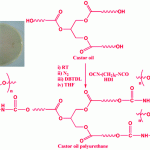

Now, Chinese researchers have developed a novel ricinoleic acid based phosphorus and nitrogen-containing flame retardant polyols (FRPE) for polyurethane sealants. The flame retardant polyols were characterized by different characterization techniques.

Flame retardant polyurethane sealants (FR-PUS) were prepared by curing flame retardant polyols with methylene diphenyl diisocyanate (MDI-50). The flame retardant properties of the polyurethane sealants were investigated using limiting oxygen index (LOI), cone calorimeter testing (CCT) and thermogravimetric analysis (TGA).

Results showed that flame retardant polyols could enhance the thermal stability and flame retardancy of polyurethane sealants without adding any other flame retardant.

Now, industries manufacturing polyurethane sealants could produce them in a renewable way which will be environmental friendly.

Source

Pure Polyurethane and Castor Oil Based Polyurethane: Synthesis and Characterization

Scientists from Malaysia performed an experiment to compare the physico-chemical properties of high performance polyurethane prepared using pure poly propylene glycol (PPG) and that prepared from PPG and castor oil.castor oil polyurethane

Characterization studies indicated the presence of large -CH stretching in castor oil mixed polyurethane with larger oxidative thermal stability over pure PPG polyurethane. The tensile properties were found to be almost comparable showing that mixed polymers can be used in future to overcome environmental and economic crisis.

Source

Production of Oriented Strand Board (OSB) with Schizolobium amazonicum and Castor Oil Based Polyurethane Resin

Researchers from Brazil performed an experiment to evaluate the feasibility of OSB Castor oilpanel production Parica (Schizolobium amazonicum) wood particles bonded by castor oil based polyurethane resin. Three different resin contents (8%, 10% and 12%) were evaluated.

Results showed that panels produced with 8% of resin content were best as they were compatible with norm requirements and used less resin in the manufacturing process. Thus Parica wood and castor oil based polyurethane resin in the OSB panels production is feasible.

Source

Electroactive Polyurethane/Siloxane Derived From Castor Oil as a Versatile Cardiac Patch

Scientists from Italy conducted an experiment to synthesize electroactive polyurethane/siloxane films from castor oil for use as a cardiac patch. The electroactive films containing aniline tetramer were prepared through sol gel reaction of trimetcastor oil polyurethanehoxysilane functional intermediate polyurethane prepolymers obtained from castor oil and polyethylene glycol.

Physicochemical, mechanical and electrical conductivity of samples were evaluated and correlated with their structural characteristics. Results showed that the prepared films were compatible with proliferation of C2C12 and had the potential to enhance myotube formation even without electrical stimulation.

Source

Synthesis and Characterization of Castor Oil-based Polyurethane for Potential Application as Host in Polymer Electrolytes

Researchers from Malaysia conducted an experiment to synthesize castor oil based polyurethane and analyse its potential application as a base material in polymer castor oil polyurethaneelectrolytes. Castor oil polyols were synthesized and mixed with 4,4′-diphenylmethane diisocyanate to synthesize the desired biobased polyurethane.

Characteristic studies showed that the synthesized polyurethane had favourable properties and hence could be used as a base material in polymer electrolytes.

Source