Lower production estimate may boost castor price

The state government and trade bodies have estimated low castor seed production in India for 2013-14, based on which, Junagadh Agriculture University (JAU) has predicted castor prices may rise from March to May.

The Department of Agricultural Economics at JAU analysed the historical monthly price data of castor collected from Agricultural Produce Marketing Committee (APMC) at Patan. Based on the econometric analysis of castor price and in consultation with the National Agricultural Innovation Project, Domestic and Export Market Intelligence Cell, Tamil Nadu Agricultural University, Coimbatore, it has been noticed that the prices of castor may remain in the range between Rs 760 and Rs 860 per 20 kg from March to May this year. “The farmers must take note of this, take their own decision to store castor and sell after May 2014. Keeping the situation in view, if export opportunities continue to remain better, there are chances that prices may go up in future days,” Maganlal Dhandhalya, associate research scientist at Department of Agricultural Economics in JAU, said.

Expecting less production and strong export demand supported by weak Indian rupee, castor price started rising from Rs 700 per 20 kg in first week of November 2013 and touched Rs 900 per 20 kg in third week of December 2013. Currently, it is priced at Rs 800 per 20 kg in various markets of Gujarat.

According to the study, export of castor oil increased over 10 per cent per annum for this year from last two years and is likely around 5.80 lakh tonnes. The domestic consumption is estimated to be about 1.50 lakh tonnes in 2013-14, which indicates that, total expected production of current will be utilized. Indian castor seed production declined from a record high of 2.29 million tonnes in 2011-12 to 1.96 million tonnes in 2012-13 and is further likely to fall about 1.64 million tonnes (as per second advance estimate dated 14-02-2014) in 2013-14, as the area under the crop shrunk from 1.47 million hectares in 2011-12 to 9,84,000 lakh hectares in 2013-14. This has been attributed to low castor prices of Rs 700 per 20 kg from March, 2012 over the last two years.


Castorseed futures fall on profit booking – March 1, 2014

Castorseed prices dropped by Rs 66 to Rs 4,360 per quintal in futures trade on 28th Feb on profit booking by traders at existing higher levels.

Marketmen said profit-booking by speculators amid a weakening spot market trend mainly influenced the sentiment.

At the National Commodity and Derivatives Exchange, castorseed prices for June contract dipped by Rs 66, or 1.49 per cent, to Rs 4,360 per quintal, with an open interest of 9,310 lots.

Most active March contract fell by Rs 46, or 1.10 per cent, to Rs 4,213 per quintal, having an open interest of 1,33,440 lots.

Source: http://www.business-standard.com/article/pti-stories/castorseed-futures-fall-on-profit-booking-114022800700_1.html

Global Castor Conference, Feb 2014, Ahmedabad

Contributor: Narasimhan Santhanam, Cofounder & Director, CastorOil.in

The Global Castor Conference 2014 was held in Ahmedabad on 22nd Feb 2014. I on behalf of CastorOil.in attended the conference.

This conference is by far the largest and most prestigious castor congregation in the world, so it was a pleasure to be present there.

This is the first of a series of blog posts I plan to write on the conference.

In this post, I will provide an overview of what happened at the conference and following this up in the next few days with details and inputs from specific sessions at the conference, and also from my interactions with a number of experts present there.

Stats

The conference had about 450 industry professionals participating, from around the world. Pretty much every important entity in the world of castor was present physically or virtually (through video conference).

The conference itself was a fairly brief affair, just one day (Feb 22nd) and five sessions.

Brief details of each session presented in this post.

Inaugural Session

Welcome Address: Vijay Data, President SEA (Solvent Extractors Association)

Brief Overview of the Castor Industry – Abhay Udeshi, Chairman, SEA Castor Seed, SEA Castor Seed & Oil Promotion Council

Address by Guests of Honour

  • Samir Shah – MD, National Commodities & Derviatives Exchange (he was replaced by a lady from the same organization)
  • Suresh Kotak , Chairman, Kotak Group of Companies

Keynote Address

  • Bhakul Dholakia, Director, Adani Institute of Infra Management

Address by Chief Guest

  • Ramesh Abhishek. Chairman, Forward Market Commission

Vote of Thanks

  • Atul Chaturvedi, Co-chairman, SEA Castor Seed & Oil Promotion Council

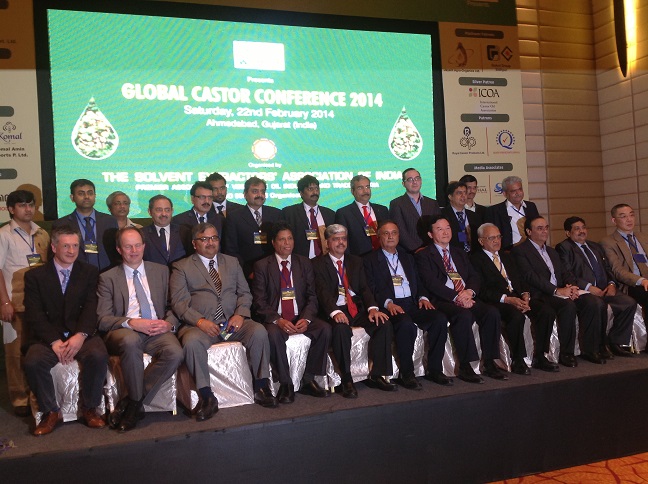
Picture of Inagural Session

Picture of the Inaugural Session

Global Castor Oil Consumption Outlook & Emerging Trend

Moderator: G Chandrashekar, Commodities Editor, Hindu Business Line, Mumbai

Panelists:

  • India: Atul Chaturevedi, Adani Wilmar, Ahmedabad
  • Europe: Hans Boloney, Technical Oils, Nidera, Netherlands
  • China: Wu Zhidong, Kong Associate
  • World: Thomas Mielke, Iste Mielke GmbH (Video presentation)

Thomas_Video Conference

Pic from the above session – L-r – Hans,
Chandrashekar, Atul, Wu. Thomas was thru video conference

Indian Castor Seed & Oil Scenario & Expectation

  • Moderator – Haresh Vyas, Royal Castor Products
  • Vikram Udeshi (Jayant Agro Organics) – Industry perspective
  • Pankaj Kumar (Adani Wilmar) – Industry perspective
  • Manoj Agarwal, Kedarnath Corp, Palanpur, Trader – Trader’s perspective
  • Alok Agarwal, Babulal Bajragnglal, Sumerpur, Trader – Trader’s perspective
  • Prahlad Singh Champavat, Farmer, Aravali Dist – Farmer’s perspective
  • Maganbhai Patel, Farmer, Palanpur – Farmer’s perspective
  • Abhisek Govilkar, Vice President. NCDEX – Exchange perspective

Pic from the castor seed & oil scenario expectation session

Pic from the castor seed & oil scenario expectation session

 Indian Castor Crop Survey (2013-14)

Naresh pednekar & Suresh Sawant – Nielsen (India)

Castor Oil Price Forecast

Nagraj Meda – Transgraph Consulting, Hyderabad

Castor Oil Price Outlook 2014 – Panel Discussion

Moderator: Shvetal Vakil from Mumbai

Participants

  • Atul Chaturvedi, Adani Wilmar
  • Abhay Udeshi, Jayant Agro Organics
  • Kanubhai Thakkar, Gokul Refoils & Solvents
  • Hans Bolomey, Technical Oils, Nidera, Netherlands
  • T. Tantiponganant, Thai Castor Industries, Bangkok
  • James Bray, Fuerst Day Lawson, London
  • Timm Wiegmann, Alberdingki Boley GmbH, Germany

L – r – Atul Chaturvedi (Adani Wilmar), Timm Wiegmann (Alberdingki Boley GmbH), James Bray (Fuerst Day Lawson), T. Tantiponganant (Thai Castor Oil), Shvetal Vakil, , Hans Bolomey (Technical Oils, Nidera, Netherlands), Kanubhai Thakkar (Gokul Refoils & Solvents), Abhay Udeshi (Jayant Agro Organics)

A Pic of the Global Castor Constellation – the global big shots all at one place

Castellation

And finally, the not so big shots 🙂 – Me (right) and Rajiv Ram who had come from LMC, UK
Narsi


This post was written by Narasimhan Santhanam, Cofounder & Director, CastorOil.in

Some interesting links

Building Energy Analytics

Some Innovative & Unique Solar Power


Manchester Gov’t Launches Production of Castor Oil Beans

THE MINISTRY of Agriculture and Fisheries of Manchester has embarked on a drive to have a sustained production of castor oil beans in the island to meet the demand of local and overseas markets.

Castor oil beans are used to manufacture a wide variety of products, including lubricants, plastics, paints, and hair and skin care ointments. The early Egyptians used it to protect their bodies from the dry desert windstorms, while in Jamaica, it is best known as a laxative to keep the bowels clean and as a hair treatment. This will be the first time that the Manchester government will be moving to have the castor plant, that grows wildly in many parishes, commercially grown as part of the productive sector

Interested farmers

During a launch of the effort at the office of the Rural Agricultural Development Agency (RADA) in Mandeville, Manchester, more than 100 small farmers turned up to participate in the programme.

Minister of Agriculture Roger Clarke, who addressed the group, told them that the production of castor oil beans presents a new opportunity to increase their earnings. Member of Parliament for south Manchester, Michael Peart, said castor oil requires low maintenance and “has the potential to alleviate the economic stress” most small farmers are experiencing.

Read More: http://jamaica-gleaner.com/gleaner/20140227/news/news5.html

Some interesting links

Building Energy Analytics

Some Innovative & Unique Solar Power


Castor oil prices will rise on tightening fundamentals

Castor market fundamentals are tightening with seed production falling and exports rising. India is the world’s largest producer and crusher of castorseed and also the largest exporter of castor oil, accounting for close to 90 per cent of world production and trade.

There are two sets of seed production data – one by the Agriculture Ministry and the other from crop survey sponsored by Solvent Extractors’ Association.

While there is no unanimity within the trade on castorseed production data, the trend is clear – seed production has continued to fall for the second consecutive year after rising to a record 2011-12.

Falling inventories

While seed production is falling, castor oil export has been rising steadily for the last four years. From 4 lakh tonnes (lt) in 2011-12, shipments increased to 4.3 lt in 2012-13 and further to 3.7 lt in the first nine months of fiscal 2013-14, with projected export for the whole year placed at 4.6 lt. Rising oil exports also imply that large inventory of seed that was built up in the last two years are being crushed to produce oil. So, inventories are falling.

At the recently-concluded Global Castor Conference 2014 in Ahmedabad, one message that stood out clearly was that the castor market fundamentals are tightening and thanks to improved global economic outlook, prices have the potential to increase sharply.

The emerging scenario will benefit castorseed growers who have been, in a sense, short-changed by speculative forces in physical and futures markets. Castorseed prices have hovered around ₹4,000-4,200 a quintal, far below the potential price that they can command given India’s dominant position in the world market.

According to Atul Chaturvedi, CEO, Adani Wilmar Ltd, India exported close to 5 lt of castor oil in 2013 and this year, prospects of a 5 per cent rise in shipments are high. China has emerged as a major buyer of Indian castor oil at 2.3 lt, followed by traditional destinations – Europe (1.3 lt) and US (45,000 tonnes), he pointed out.

Source: http://www.thehindubusinessline.com/opinion/columns/g-chandrashekhar/castor-oil-prices-will-rise-on-tightening-fundamentals/article5729036.ece

Castor can be grown in Florida using proper management techniques: Study

A new University of Florida study shows that castor can be grown in Florida again using proper management techniques. Those techniques include spacing plants properly and using harvest aids to defoliate the plant when it matures.

The study says that castor has not been grown in the U.S. since 1972, because the federal government discontinued giving price supports. Growers in the U.S. want to mechanically harvest castor, which is typically hand-picked in other parts of the world, the researchers said. Among other things, the UF/IFAS study evaluated whether the plant would grow too tall for mechanical harvesting machines.

At UF research units in Citra and Jay, scientists tested Brigham and Hale, two types of castor that were bred in an arid part of west Texas near Lubbock in 1970 and 2003, respectively. These cultivars are shorter than castor found in the wild, said Diane Rowland, an associate professor of agronomy at UF’s Institute of Food and Agricultural Sciences, and Campbell’s faculty adviser.

By spraying the plants with a chemical, Scientists tried to control the growth of them. Even though the crop didn’t respond to the chemicals, it did not grow taller than expected. So it appears these types of castor can be harvested mechanically, she said.

The study came about after a few growers in South Florida who wanted to plant castor asked IFAS administrators for technical advice, Rowland said.

More: http://www.newswise.com/articles/uf-ifas-study-shows-promise-for-castor-crop-planting-in-florida

Some interesting links

Building Energy Analytics

Some Innovative & Unique Solar Power

NCDEX Slashes Transaction Charges

India’s second largest commodity trading platform, has slashed transaction charges in non-deliverable commodities following approval to introduce “differential transaction charges” by the derivatives market regulator the Forward Markets Commission (FMC).

With this effect, NCDEX will charge Rs 1.95 for every Rs 1 lakh of turnover in refined soya oil, soybean and castor seed etc. for brokers generating monthly average daily traded value (ADTV) of Rs 200 crore. Over and above of this slab, however, the transaction charges will be slashed further to Rs 1.30 for every Rs 1 lakh of turnover.

Similarly, traders generating ADTV upto Rs 50 crore in gold hedge, crude oil, crude palm oil, steel etc will have to pay Rs 0.40 per Rs 1 lakh of turnover. On the incremental monthly ADTV, a transaction fee of Re 0.30 for every 1 lakh of turnover will be charged. This would make it extremely cost effective for participants, NCDEX said in a statement.

Source:http://www.business-standard.com/article/markets/ncdex-slashes-transaction-charges-114021801122_1.html


Castor growing farmers demand minimum support price castor seed at ₹70,000/tonne (around US$ 1130 /ton)

Amid lower castor prices, Gujarat wing of Bharatiya Kisan Sangh (BKS) – a farmers’ body has demanded fixation of minimum support price (MSP) for castor at ₹70,000 (USD 1130/ton) a tonne.

According to farmers, prices have tumbled to lower levels that are not remunerative for growers.

“MNCs and their Indian agents to fulfil their export obligation are forcing Indian castor farmers to sell their crop at non-remunerative prices of ₹41,000-44,000 PMT () (whereas input cost stands at ₹60,000-70,000 PMT(US$ 970-1130/PMT) ),” BKS stated in a statement.

The farmers’ body has appealed to the Central Government to announce minimum support price of ₹70,000 a tonne for Castor Seed and minimum export value of $2,000 PMT for castor oil.

Further, BKS has also urged the commodity exchanges and the commodities market regulator – Forward Market Commission (FMC) to impose additional cash margin on the sell side to safeguard farmers from falling prices of castor seed.

Source:http://www.thehindubusinessline.com/economy/castor-growing-farmers-demand-minimum-support-price-castor-seed-at-70000tonne/article5677745.ece