Fulgar Develops Castor Oil-Based Fibre

Italian synthetic fibre business Fulgar has launched a new high performance nylon fibreFulgar made from biopolymer extracted from castor oil seed.

The fibre, Evo, is suitable for all applications, particularly, for the sports sector as it is ultra-light, stretchy and easily breathable.
Source

Synthesis and Characterization of Castor Oil-based Polyurethane for Potential Application as Host in Polymer Electrolytes

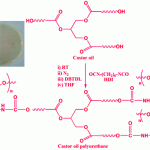
Researchers from Malaysia conducted an experiment to synthesize castor oil based polyurethane and analyse its potential application as a base material in polymer castor oil polyurethaneelectrolytes. Castor oil polyols were synthesized and mixed with 4,4′-diphenylmethane diisocyanate to synthesize the desired biobased polyurethane.
Characteristic studies showed that the synthesized polyurethane had favourable properties and hence could be used as a base material in polymer electrolytes.

Source

Versatile Post-Polymerization Modifications of a Functional Polyester from Castor Oil

Researchers from Spain performed an experiment to analyse post-polymerization modifications of a functional polyester derived from castor oil. castor oilThe aliphatic functional polyester was obtained by enzymatic polycondensation of dimethyl 2,9-dibromosebacate and 1,10-decanediol derived from castor oil.
Results showed that the alkyl halide functionality reacted with thiols, amines and carboxylic acid under mild conditions showing high modification degrees.

More

Wound Healing Bionanocomposites Based on Castor Oil Polymeric Films Reinforced with Chitosan-Modified ZnO Nanoparticles

Researchers from Spain used castor oil as a matrix material to prepare biocompatible and biodegradable nanocomposite films filled with chitosan modified ZnO nanoparticles for wound healing. The biocomposites were prepared by solution mixing and casting method. The morphology, structure and wound healing properties of Castor oilthe films were analysed. The antibacterial activity of the films were investigated in the presence and absence of UV light.
Results showed that the antibacterial activity was stronger against gram positive bacteria. Composites with nanoparticle loading enabled faster wound healing thus showing the potential to be applied as antibacterial wound dressings.

Source

Epoxidation and Polymerization of Acrylated Castor Oil

Scientists from Turkey conducted a study to investigate a new type of bifunctional Castor oilmonomer obtained from castor oil. Castor oil was first reacted with acryloyl chloride to obtain acrylated castor oil. Epoxidized acrylated castor oil obtained after epoxidation reaction was characterized using various techniques.

After characterization, homo and block copolymers were synthesized and evaluated. It was observed that epoxidized acrylated castor oil copolymer showed higher storage modulus and higher thermal stability.

More

Effect of Castor Oil as an Auxiliary Stabilizer in the Production of Flexible Polyurethane Foams

Researchers from Nigeria performed an experiment to castor oil polyurethaneanalyze the effect of castor oil as an auxiliary stabilizer in the production of polyurethane foams.  Castor oil was used as a substitute to silicone oil at different percentages.

The results showed that castor oil could be a best partial substitute for silicone oil at higher densities.

Source

Synthesis of Bio-Castor Oil Polyurethane Flexible Foams and the Influence of Biotic Component on their Performance

Scientists from China conducted an experiment to synthesize bio-castor oil polyurethane flexible foams and study the influence of biotic component on their performance. A series of biobased polyurethane foams were synthesized bCastor oil polyurethaney substituting polyether polyol with castor oil and polyethylene glycol (PEG). The influence of castor oil component on the structure and physical properties of polyurethane foams were studied.

Results showed that the Young’s modulus and compression resilience improved with increased content of castor oil. They also exhibited lower water absorption and higher contact angle with increase in content of castor oil.

Source

Studies on Interfacial Tension and Contact Angle of Synthesized Surfactant and Polymeric from Castor Oil for Enhanced Oil Recovery

Researchers from India performed an experiment to study interfacial tension and contact angle of synthesized surfactant and polymeric from castor oil. The polymeric surfactant was synthesized from pre-synthesized sodium methyl ester sulfonateCastor oil (surfactant) and acrylamide for application in chemical enhanced oil recovery.

The synthesized surfactant and polymeric surfactant were used to measure interfacial tension between their aqueous phase and crude oil phase. Contact angles of solid-crude oil-surfactant interface were also measured. Results showed that interfacial tension was lower which is effective for oil recovery.

More

Influence of NCO/OH and Transesterified Castor Oil on the Structure and Properties of Polyurethane: Synthesis and Characterization

Scientists conducted an experiment to analyze the influence of isocyanate, hydroxyl groups and transesterified castor oil on the structure and properties of polyurethane. castor oil polyurethane Polyurethane was synthesized using transesterified castor oil and partially Biobased isocyanate with varying concentrations of isocyanate and hydroxyl groups.

The chemical and mechanical properties, thermal stability of polyurethanes were analyzed. Results showed that NCO/OH molar ratio had profound effect on the tensile properties and modulus of polyurethanes.

Source

Biocompatibility and Osteogenesis of the Castor Bean Polymer Doped with Silica (SiO2) or Barium Titanate (BaTiO3) Nanoparticles

Scientists from Brazil conducted an experiment to evaluate the biocompatibility and osteogenesis of castor oil polymer doped with SiO2 or BaTiO3 nanoparCastoroil polymerticles.

Twenty-four rats with bone defect were experimented with castor oil polymer doped with SiO2 or BaTiO3. Euthanasia occurred 30 and 60 days after surgery and the femurs were sent to histological analysis and MEV. Results showed that the implants were biocompatible and allowed for progressive osteogenesis.  Thus, castor oil polymer doped with SiO2 or BaTiO3 remains biocompatible and allows for osteogenesis.

Source