Rajkot Castor Seeds Futures Open- Feb 05

Castor seed future March contract eased in the early trades due to lack of speculative buying.

Castor seed futures, in rupees per 100 kilograms, in the Rajkot market,

According to the Rajkot Commodity Exchange:

March Contract

Today’s open               3,998.00

At 1215 local time         3,991.00

Previous close             3,992.00

Source

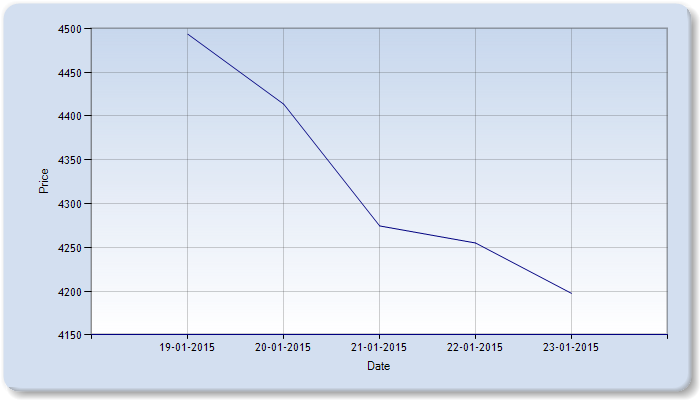
Castor Seed Price Weekly Report: January 19-23, 2015

CastorOil.in brings you the weekly report of castor seed price at NCDEX.

A steady decrease in the price of castor seed is noticed this week.

Check out the table and the graphical data.

Price Date Rupees Per Quintal
19 January 4493.5
20 January 4413.6
21 January 4274.65
22 January 4255.15
23 January 4197.7

Castor Seed Price Weekly Report: January 19-23, 2015

Source

Castor Cultivation and Yields in China

The table below provides the production rate of castor seed in china, during the years 2011-12 and 2012-13.

  Production (‘000 T) Area Harvested(‘000 Ha)        Yield  (T/H)
175 180 210 210 0.86 0.86

It can be seen from the above table that the yields of castor seeds in China are almost on par of those in India (which is about 1 T/ha/year. An earlier post showed how the yield is far lower in Brazil.

China is the second largest producer of castor. It contributes about 7-10% of the world‘s castor seeds production.  It uses about 60% of its castor oil for the production of Sebacic acid.

In 2011, China exported 0.13 million T of castor oil, which increased to 0.18 million T in 2012 and estimated to be 0.17 million T in 2013.

Emerging Application of Castor oil in Personal Care Sector

Castor oil and derivatives are widely used in soaps, creams (tretinoin), shampoos, perfumes, lip gels, lipsticks, hair oils, deodorants, lubricants, sunscreens, and other personal care products.

It has been used in skin care products for centuries, and continues to play an important part in soaps and cosmetics.

Cosmetics manufacturers use castor oil and its derivatives in formulating non-comedogenic cosmetics (cosmetics that don’t exacerbate or contribute to acne) and emollients.

The major companies using castor oil for cosmetics are given in the table.

Company Country Products castor derivatives used in Derivative Used
Lavera USA Deodorants, body lotion, sunscreen Zinc ricinoleate and HCO
Avene USA Deodorant Zinc ricinoleate
Jason USA Body lotion and deodorants Zinc ricinoleate
Arkema France Hair care, beauty creams Undecylenic acid
Aveya Beauty USA Hair care products Castor oil basic grades
Worlee Cosmetics Germany Natural exfoliants HCO

The global demand for organic personal care products is expected to reach $13.2 billion by 2018, growing at a CAGR of 9.6 per cent.

Castor today contributes only a small % to this sector, but the potential is much higher.

Applications of Castor oil in Specialty Chemicals and Biofuels Market

Castor Oil for Specialty Chemicals

Specialty chemicals market is a $700 billion + market worldwide, with high profit margins.

Given castor oil unique versatility, there could be a number of niche applications within specialty chemicals, other than the ones already exploited.

More “entrepreneurial” research needs to be undertaken in this direction.

Castor Oil for Biofuels

While there has been a lot of debate about the use of castor oil for biodiesel, we feel that it is not a viable route. Sure, technically castor oil might be suitable to make biodiesel, except perhaps for its high kinematic viscosity, which could even be taken care of during transesterification.

The more important dimensions are the economics and volumes which make castor oil quite unattractive as a feedstock for biodiesel:

  • Economics – Price of biodiesel needs to be in the range $900-$1000 per ton; price of castor oil alone is $1300/T.
  • Volumes – World produces about 20 million T of biodiesel every year; world castor oil production is less than 1 million T!

In fact, we have been generous on the price aspect. If the current downtrend in crude prices continues, biodiesel might have to sell at less than $700 per T. We dont see how castor oil could support such a price.

On volumes, castor is produced in such small quantities, it really is going to make little difference overall to the biodiesel market.

And when especially the same castor oil oil could be sold at a much higher price to end users who would be willing to pay a much higher price for the oil or the derivative, we do not see how castor oil biodiesel could work out on any sizable scale.
Yield, Productivity and Toxicity Challenges in Castor Industry

There are three major issues with respect to castor yield and productivity challenges. They are

  • Castor cultivation of crop on marginal lands without inputs (fertilizers and irrigation) produces poor yields
  • Lack of improved varieties and hybrids
  • Lack of mechanization in cultivation & harvesting

Toxicity Challenge

  • The ricin in castor crop is a barrier to its cultivation in many developed countries – especially US and parts of Europe
  • GM castor with no ricin could be a solution

Apart from this, there are other challenges faced in castor industry. They are:

  • Difficulty in further expansion of area in India primarily due to lack of seed marketing to non-traditional areas
  • Grown under rain-fed condition without following improved package of practices
  • Lack of suitable cultivars for intercropping system
  • Lack of resistant/ tolerant varieties/hybrids for eating caterpillars and macrophomma disease

Possible Solution to Overcome Price and Supply Volatility Challenge

With India dominating castor production with over 80% of the total global production, it gives rise to a number of constraints and challenges. One of them being the price and supply volatility owing to the entire world depending on one country for supplies.

Thus, one of the ways to overcome the price and supply volatility challenge is to increase the geographical diversity of cultivation.

Emerging Geographies are

Americas

  • Mexico

Africa

  • Ethiopia
  • Angola
  • South Africa

Asia & Middle East

  • Thailand
  • Vietnam
  • Philippines
  • Israel

Emerging Techniques and Research to Increase Yield in Castor

Increasing the yield of castor from 1 T/hectare per year (the average right now in India) to something much higher is a highly desirable outcome, but not very easy.

The best way to overcome yield challenge in castor industry is to concentrate more on research and development (R&D) area.

Many techniques are emerging in R&D sector to increase the yield of castor. These include

  • Hybrids: Selection of Hybrids to increase yield, branching, non-shattering and high oil content. e.g.- HC1, HC2,…8 also, advanced hybrids like TSP 10R VP1 lata, etc.
  • Cross Pollination: Under natural conditions, cross pollination in castor can exceed 80%, but the actual level of cross pollination is dependent on both genotype and environmental conditions. Germplasm storage under cryogenic conditions keeps up the viability of seeds even after 30 days
  • Other techniques like enriching the soil with zinc content

High Yield Castor Varieties in India

While India currently average about 1 T/hectare per year for castor seeds, there is potential for much higher yield.

As part of the research to increase yields, efforts have been going on in India for high yielding varieties of castor.

The table below shows the various high yielding castor varieties produced by different states across India.

State Variety Hybrid
Andhra Pradesh Aruna, Bhagya, Sowbhagya, Kranti (PCS-4), Jwala, DCS-9
(Jyothi), Kiran (PCS-136), Haritha (PCS-124).
Uttar Pradesh Kalpi-6, T-3, T-4
Gujarat GAUC-1, VI-9, S-20, J-1andGCH 7 CH-1, GCH-2, GCH-3, GCH6, SHB-145, GCH-7 and(SKP 84 x SKI 215
Tamil Nadu TMV-1, TMV-2, TMV-3, TMV-5, SA-1, SA-2, TMV-4,Jyothi, CO-1 TMVCH-1and TMVCG*
Karnataka Jwala (48-1), RC-8, Jyothi
Maharashtra AKC-1, Girija GCH-6
Rajasthan GCH-6, RHC-1
Haryana CH-1
Punjab Pb. No.1
For all states Gujarat Castor-2 DCH-32 (Deepti)DCH-177 (Deepak)GCH-4, GCH-5, DCH 519
For entire country DCH 519 M 574 x DCS 78