Castor Oil and castor Oil Derivatives Production in India

This post provides details of castor oil and castor derivatives production in India.

Castor Oil Production

The castor oil production in India was 0.55 million tons in the year 2011-12 and 0.56 lakh tons in 2012-13.

Country 2011-12(million tons) % of world total 2012-13(lakh tons) % of world total
India 0.55 79% 0.56 82%

Castor Derivatives Production

The production range of various castor oil derivatives is given in the following table expressed in tons/annum (TPA).

 Castor Oil Derivative Name Installed Capacity TPA
Hydrogenated Castor oil 50,000
12-Hydroxy Stearic Acid 30,000
Dehydrated Castor Oil 17,500
Ricinoleic Acid (RA) and Methyl Ricinoleic Acid 6,500
Blown Castor oil (SCO) 2,500
Sebacic Acid 10,500
Undecylenic Acid and their Salts 2,500
Heptaldehyde 1,500
Ethoxylated Castor oil 3,000

Castor Farming in India – Structure, Constraints and Contract Farming

Castor Farming Structure in India

In India, there are both independent farmers and contract farmers, but the significant majority comprises independent farmers. There are thousands of small, independent castor crop farmers in India, ownership ranging from just a couple of hectares to hundreds of hectares.

Constraints Faced by Indian Castor Farmers

The constraints reported by farmers include

  • Poor monetisation of their crop
  • Harvesting problems
  • Occurrence of pests and diseases

Castor Contract Farming in India

Even in contract farming, it has been seen that contract periods are not long duration, typically a couple of years.  However, some recent efforts are made by corporates to do contract farming in Gujarat, AP and Odisha.

It is observed that the cultivation of castor under contract farming is a profitable proposition under dry land condition, and estimates suggest that the returns are more remunerative than in the case of independent farming.

Castor Trade Logistics – Supply Chain and Distribution Channels for the Castor Seed and Castor Oil Industry

Within India, the leading country for castor seeds and castor oil, the logistics and distribution for both seeds and oil follow some specific patterns.

This blog post provides more details on this aspect of the castor industry.

Distribution of castor seeds in India follows a particular process.

The process mentioned below is representative of a typical distribution of castor seeds in India.

  • Castor seeds are bought to the auction place from the farms
  • At the auction place, traders buy the castor seeds through an auction process. There are many traders who do this in each city
  • Then, there are a few large brokers who interact with the traders and who in turn are contacted by the crushers & refiners for purchase

The supply chain thus looks as follows:

castor

Pricewise, if X (Rs) is the price per Kg when it is auctioned, the price at which the crusher receives it is about 1.05 X (a 5% increase). This increase results by way of commissions to traders and brokers and for transport costs to the crushing unit.

Brazil Castor Seed and Castor Oil Production, Castor Companies

While India leads the castor oil producing countries, being heads and shoulders above the rest, China and Brazil are two other countries that are (still) in the picture.

This post provides some data and details on castor production in Brazil.

Poor Yields

The table below provides details for castor seed production in Brazil during the year 2011-12 and 2012-13.

Production (‘000/T) Area Harvested(‗000/Ha) Yield  (T/H)
25 141 128 219 0.19   0.64

As we can see from the above, the yields for Brazil appears really low – I mean, 200 Kg per hectare (for 2011-12) is a really poor number. The yield for 12-13 (640 Kg) is a far better number, hopefully this will be repeated for 13-14 and further.

Compare the above data with the average Indian yields, which are about 1000 kg/ha.

Now, there are folks who feel even 1 T / ha/year is fairly poor, so just imagine what they would say to the average yields in Brazil in the recent past.

(There are reports of some improved open-pollinated varieties in Brazil yielding 1,300 kg/ha, with reports of exceptional yields going up to 5,000 kg/ha, but then these are exceptions and not the rule).

Prominent Castor Oil & Derivatives Producers in Brazil

Company Location
Bom Brasil Salvador, BA
A.Azevedo Itupeva, SP
Enovel Bariri, SP

Effect of Modified Silica Nanoparticle on the Properties of Bio-Based Polyurethane

nanocompositesResearchers developed bio-based polyurethane (BPU) using a castor oil/poly (ε-caprolactone) hybrid polyols and hydrophobic BPU ultrafine fibres containing modified silica (m-silica) by electrospinning process. The rheological analysis of the network structure between the BPU and m-silica showed improved mechanical properties and thermal stability. The average fibre diameter of the hybrid ultrafine fibres decreased with increasing m-silica content. Moreover, the m-silica nanoparticle provided an effective surface wettability to BPU ultrafine fibres, thus making it a hydrophobic molecule. All these improved properties makes BPU/m-silica ultrafine fibres, a better replacement for petroleum-based polyurethane membrane, thus allowing its application in the field of bio filters, eco-friendly textiles, and biomedical engineering.


Source


Growing Castor Oil Industry

Castor oil manufacturing is similar to that of other oil seeds and hence it can be manufactured by utilizing the existing equipments that are locally available. The castor seeds contain about 48 – 50% oil by weight. After extraction, the oil can be further processed to get a number of derivatives which can be used in various industrial applications. The average seed yields range from 900 – 1000 kg/ha under irrigation.

India is the leading producer of castor seeds followed by China. Fuerst Day Lawson is pioneering in castor oil supply in Europe, with over 40 years’ experience buying directly from the producers of India, China and Brazil.C_plant

Castor oil, is not only as a lubricant, but also play a vital role in the polymer industry as it is gives polyamide-nylon 11.

The global market for generation II castor oil derivatives is estimated at about $300 million. Some of the high yielding varieties of castor oil in India are NPH-1 (Aruna), GAUCH-4 and TMVCH.

Know more from Comprehensive Castor Oil Report

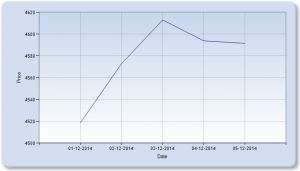
Castor Seed Price Weekly Report: December 01-05, 2014

Castor seed price had been moving ahead gradually during the week in concern. Yet there was a mild deflation at the end of the week, which is quite an usual scenario.

Check out the table and the graphical data.

Price Date
Rupees per Quintal
01 Dec 4518.9
02 Dec 4572.95
03 Dec 4612.85
04 Dec 4593.75
05 Dec 4591.45

Dec 01 - 05


Source

Gujarat Farmers’ Urge to Ban Castor Seed Futures Trading

images (6)Gujarat farmers have urged the commodity derivatives regulator the Forward Markets Commission (FMC) to ban futures trading in castor seed due to high volatility in the past few weeks.

Average castor seed price jumped 17.83% in October 2014 to 44,000 a tonne in Gujarat spot market, compared to 37,553 a tonne in November 2013, data compiled by the Solvent Extractors’ Association showed.

During the week to November 28, however, castor seed price declined 3.28 per cent to Rs 44,250 a tonne. Castor seed for delivery in April 2015 jumped 2.4 percent on 3rd December to trade at Rs 4,812 a quintal on the NCDEX.

Therefore, the farmers want to ban futures trading in castor seed in case excessive speculative activities are witnessed in this counter on commodity exchanges.

Source

Castor Meal to Replace Soybean Meal as Lamb Feed

Researchers at Brazil conducted a study to understand the effect of replacement of soybean meal by wet or dry castor bean meal in diets of feedlot lambs. They assessed animal performance, carcass traits, intake, digestibility and hepatic function.

Control animals were fed with soybean meal while lambs for test were casfed with dry or wet castor meal treated with calcium hydroxide for 70 days. Lambs were slaughtered and evaluated at the end of 70 days. Dry matter intake and digestibility, final body weight, average daily gain and carcass weights were not affected by the substitution of soybean meal by castor source.

Serum levels of aspartate aminotransferase and alanine aminotransferase enzymes did not differ among treatments indicating no effect of treated CM on hepatic function.

The results show that the castor meal can completely replace soybean meal in the diet of finishing lambs without negative impacts.

Source