Polyurethane–Organoclay Nanocomposites Based on Castor Oil Polyols

Researchers from University of Technology, Baghdad, have synthesized castor oil-based polyurethanes–organoclay (COPUs-Cloisite 30B) nanocomposites by mixing polypropylene glycol polyol and dehydrated castor oil (15 %), with C30B nanofillers at different weight percentages. Various analyses such as OLYMPUS DIGITAL CAMERAFourier Transform Infrared Spectroscopy, Fourier scanning Electron Microscopy, Scanning Electron Microscopy and X-ray diffraction were performed to evaluate the physico-chemical properties of COPUs-Cloisite 30B. Thermal stability and tensile strength were found to improve upto ~30 C and ~240% respectively, with 5 wt% of C30B . These improved properties allow it to be used in coatings, adhesives and automotives.
Source

Read more about castoroil-based polyurethanes
Polyols Based on Organosolv Lignin and Fatty Acids

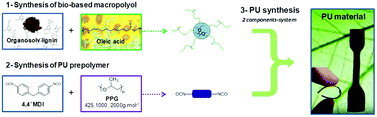
Scientists from University of Strasbourg, France, published results of their recent research on Bio based building blocks for segmented Polyurethanes. A macropolyol was prepared by combining two different biomolecules- lignin and oleic acid, from biomass. NMR and FT-IR analyses are performed to determine the chemical structure of the lignic- fatty acid based polyol. Polyurethanes preolymers are synthesised from 4,4′-methylenebis(phenyl isocyanate) and poly(propylene)glycol of different molecular weights (PPG – 425, 1000 and 2000 g mol−1. ).

On varying the reaction parameters, in the presence of lignin- fattyacid based macropolyol, different PU macromolecular architectures were obtained. The chemical structure of the lignin- based polyurethane was analysed by FT-IR, and the properties of polymers by DSC, TGA, DMTA, and tensile test experiments. Thus obtained new polymers is found to posses advanced properties and may serve as an optimal alternative to conventional polyurethanes. Full Article

Want to know about Castor oil based Polyurethanes, click the link below:

http://www.castoroil.in/application/castoroilbasedpolyurethanes.html

View blog posts on Castor oil Polyurethanes

Rigid foam polyurethane derived from castor oil for thermal insulation in roof systems

Paper Abstract

This paper discusses the response of the thermal insulation lining of rigid foam polyurethane (PU) derived from castor oil (Ricinus communis) in heat conditions, based on dynamic climate approach. Liners have been widely used, because the coverage of buildings is responsible for the greatest absorption of heat by radiation, but the use of PU foam derived from this vegetable oil is unprecedented and has the advantage of being biodegradable and renewable. The hot wire parallel method provided the thermal conductivity value of the foam. The thermogravimetric analysis enabled the study of the foam decomposition and its lifetime by kinetic evaluation that involves the decomposition process. The PU foam thermal behavior analysis was performed by collecting experimental data of internal surface temperature measured by thermocouples and assessed by representative episode of the climatic fact. The results lead to the conclusion that the PU foam derived from castor oil can be applied to thermal insulation of roof systems and is an environmentally friendly material.

Read the full article here –http://www.sciencedirect.com/science/article/pii/S2095263512000696