Castorseed futures fall on profit booking – March 1, 2014

Castorseed prices dropped by Rs 66 to Rs 4,360 per quintal in futures trade on 28th Feb on profit booking by traders at existing higher levels.

Marketmen said profit-booking by speculators amid a weakening spot market trend mainly influenced the sentiment.

At the National Commodity and Derivatives Exchange, castorseed prices for June contract dipped by Rs 66, or 1.49 per cent, to Rs 4,360 per quintal, with an open interest of 9,310 lots.

Most active March contract fell by Rs 46, or 1.10 per cent, to Rs 4,213 per quintal, having an open interest of 1,33,440 lots.

Source: http://www.business-standard.com/article/pti-stories/castorseed-futures-fall-on-profit-booking-114022800700_1.html

Global Castor Conference, Feb 2014, Ahmedabad

Contributor: Narasimhan Santhanam, Cofounder & Director, CastorOil.in

The Global Castor Conference 2014 was held in Ahmedabad on 22nd Feb 2014. I on behalf of CastorOil.in attended the conference.

This conference is by far the largest and most prestigious castor congregation in the world, so it was a pleasure to be present there.

This is the first of a series of blog posts I plan to write on the conference.

In this post, I will provide an overview of what happened at the conference and following this up in the next few days with details and inputs from specific sessions at the conference, and also from my interactions with a number of experts present there.

Stats

The conference had about 450 industry professionals participating, from around the world. Pretty much every important entity in the world of castor was present physically or virtually (through video conference).

The conference itself was a fairly brief affair, just one day (Feb 22nd) and five sessions.

Brief details of each session presented in this post.

Inaugural Session

Welcome Address: Vijay Data, President SEA (Solvent Extractors Association)

Brief Overview of the Castor Industry – Abhay Udeshi, Chairman, SEA Castor Seed, SEA Castor Seed & Oil Promotion Council

Address by Guests of Honour

  • Samir Shah – MD, National Commodities & Derviatives Exchange (he was replaced by a lady from the same organization)
  • Suresh Kotak , Chairman, Kotak Group of Companies

Keynote Address

  • Bhakul Dholakia, Director, Adani Institute of Infra Management

Address by Chief Guest

  • Ramesh Abhishek. Chairman, Forward Market Commission

Vote of Thanks

  • Atul Chaturvedi, Co-chairman, SEA Castor Seed & Oil Promotion Council

Picture of Inagural Session

Picture of the Inaugural Session

Global Castor Oil Consumption Outlook & Emerging Trend

Moderator: G Chandrashekar, Commodities Editor, Hindu Business Line, Mumbai

Panelists:

  • India: Atul Chaturevedi, Adani Wilmar, Ahmedabad
  • Europe: Hans Boloney, Technical Oils, Nidera, Netherlands
  • China: Wu Zhidong, Kong Associate
  • World: Thomas Mielke, Iste Mielke GmbH (Video presentation)

Thomas_Video Conference

Pic from the above session – L-r – Hans,
Chandrashekar, Atul, Wu. Thomas was thru video conference

Indian Castor Seed & Oil Scenario & Expectation

  • Moderator – Haresh Vyas, Royal Castor Products
  • Vikram Udeshi (Jayant Agro Organics) – Industry perspective
  • Pankaj Kumar (Adani Wilmar) – Industry perspective
  • Manoj Agarwal, Kedarnath Corp, Palanpur, Trader – Trader’s perspective
  • Alok Agarwal, Babulal Bajragnglal, Sumerpur, Trader – Trader’s perspective
  • Prahlad Singh Champavat, Farmer, Aravali Dist – Farmer’s perspective
  • Maganbhai Patel, Farmer, Palanpur – Farmer’s perspective
  • Abhisek Govilkar, Vice President. NCDEX – Exchange perspective

Pic from the castor seed & oil scenario expectation session

Pic from the castor seed & oil scenario expectation session

 Indian Castor Crop Survey (2013-14)

Naresh pednekar & Suresh Sawant – Nielsen (India)

Castor Oil Price Forecast

Nagraj Meda – Transgraph Consulting, Hyderabad

Castor Oil Price Outlook 2014 – Panel Discussion

Moderator: Shvetal Vakil from Mumbai

Participants

  • Atul Chaturvedi, Adani Wilmar
  • Abhay Udeshi, Jayant Agro Organics
  • Kanubhai Thakkar, Gokul Refoils & Solvents
  • Hans Bolomey, Technical Oils, Nidera, Netherlands
  • T. Tantiponganant, Thai Castor Industries, Bangkok
  • James Bray, Fuerst Day Lawson, London
  • Timm Wiegmann, Alberdingki Boley GmbH, Germany

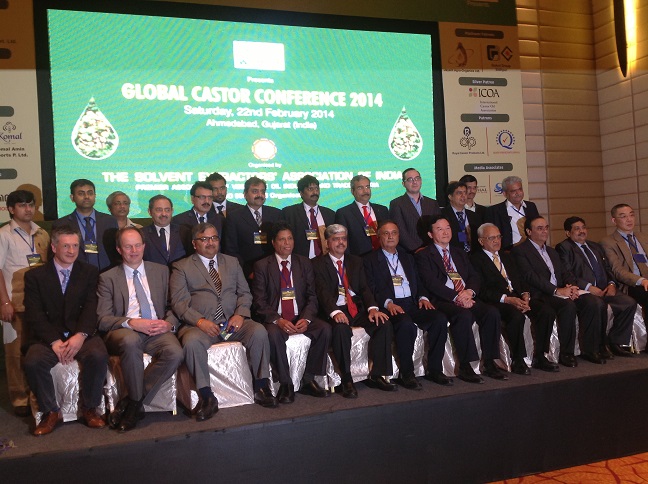
L – r – Atul Chaturvedi (Adani Wilmar), Timm Wiegmann (Alberdingki Boley GmbH), James Bray (Fuerst Day Lawson), T. Tantiponganant (Thai Castor Oil), Shvetal Vakil, , Hans Bolomey (Technical Oils, Nidera, Netherlands), Kanubhai Thakkar (Gokul Refoils & Solvents), Abhay Udeshi (Jayant Agro Organics)

A Pic of the Global Castor Constellation – the global big shots all at one place
Castellation

And finally, the not so big shots 🙂 – Me (right) and Rajiv Ram who had come from LMC, UK

Narsi


This post was written by Narasimhan Santhanam, Cofounder & Director, CastorOil.in

Some interesting links

Building Energy Analytics

Some Innovative & Unique Solar Power


Castor oil prices will rise on tightening fundamentals

Castor market fundamentals are tightening with seed production falling and exports rising. India is the world’s largest producer and crusher of castorseed and also the largest exporter of castor oil, accounting for close to 90 per cent of world production and trade.

There are two sets of seed production data – one by the Agriculture Ministry and the other from crop survey sponsored by Solvent Extractors’ Association.

While there is no unanimity within the trade on castorseed production data, the trend is clear – seed production has continued to fall for the second consecutive year after rising to a record 2011-12.

Falling inventories

While seed production is falling, castor oil export has been rising steadily for the last four years. From 4 lakh tonnes (lt) in 2011-12, shipments increased to 4.3 lt in 2012-13 and further to 3.7 lt in the first nine months of fiscal 2013-14, with projected export for the whole year placed at 4.6 lt. Rising oil exports also imply that large inventory of seed that was built up in the last two years are being crushed to produce oil. So, inventories are falling.

At the recently-concluded Global Castor Conference 2014 in Ahmedabad, one message that stood out clearly was that the castor market fundamentals are tightening and thanks to improved global economic outlook, prices have the potential to increase sharply.

The emerging scenario will benefit castorseed growers who have been, in a sense, short-changed by speculative forces in physical and futures markets. Castorseed prices have hovered around ₹4,000-4,200 a quintal, far below the potential price that they can command given India’s dominant position in the world market.

According to Atul Chaturvedi, CEO, Adani Wilmar Ltd, India exported close to 5 lt of castor oil in 2013 and this year, prospects of a 5 per cent rise in shipments are high. China has emerged as a major buyer of Indian castor oil at 2.3 lt, followed by traditional destinations – Europe (1.3 lt) and US (45,000 tonnes), he pointed out.

Source: http://www.thehindubusinessline.com/opinion/columns/g-chandrashekhar/castor-oil-prices-will-rise-on-tightening-fundamentals/article5729036.ece

Castor growing farmers demand minimum support price castor seed at ₹70,000/tonne (around US$ 1130 /ton)

Amid lower castor prices, Gujarat wing of Bharatiya Kisan Sangh (BKS) – a farmers’ body has demanded fixation of minimum support price (MSP) for castor at ₹70,000 (USD 1130/ton) a tonne.

According to farmers, prices have tumbled to lower levels that are not remunerative for growers.

“MNCs and their Indian agents to fulfil their export obligation are forcing Indian castor farmers to sell their crop at non-remunerative prices of ₹41,000-44,000 PMT () (whereas input cost stands at ₹60,000-70,000 PMT(US$ 970-1130/PMT) ),” BKS stated in a statement.

The farmers’ body has appealed to the Central Government to announce minimum support price of ₹70,000 a tonne for Castor Seed and minimum export value of $2,000 PMT for castor oil.

Further, BKS has also urged the commodity exchanges and the commodities market regulator – Forward Market Commission (FMC) to impose additional cash margin on the sell side to safeguard farmers from falling prices of castor seed.

Source:http://www.thehindubusinessline.com/economy/castor-growing-farmers-demand-minimum-support-price-castor-seed-at-70000tonne/article5677745.ece

Castor seed Prices Could Decline due to Selling Pressure from Bear Operators – February, 2014

According to Reuters, castor seed future March contract will decline owing to selling pressure from bear operators.

As of February 7th 2014, on the Rajkot Commodity Exchange castor seeds ready price are quoted at ₹3,882.50 a quintal (₹ 38.9/kg or USD 625/ton)

On the NCDX, castor seeds with a expiry date of March 20, 2014 as of February 10th is being traded at ₹ 4138 a quintal (US$ 665/ton), the previous close was at ₹4077 a quintal (US$ 655/ton)

Studies indicate that the castor oil prices as of February 7, 2014  in Rotterdam is about US$1700/ton (Source: oilworld.ru)

As per the solvent extractors unit of India, castor oil is being exported at ₹830 for 10 kg (US$ 1337/ton). As of January 2014, the castor oil prices have risen by Rs 50 to Rs 9350-9450 per quintal(US$ 1500 – 1521/ton) on increased offtake by consuming industries (Source: Business Standard)

As of February 10th 2014, the castor deoiled cake is ₹4300/ton (US$69/ton)

Castor Price Volatility – Price drop 12% on weak export demand

At the spot market, castor price had reached to Rs 920-925 per 20 kg bag But soon after that, castor seedprices started declining as demand for export came down and now it is being traded at Rs 800-810 per 20 kg. Prices, therefore, have decreased nearly 12 per cent or Rs 110 per 20 kg .

On the National Commodity and Derivatives Exchange (NCDEX), the castor seed contract for February 2014 went down by about 16 percent during a week. NCDEX February contract was traded on Rs 4,248 per quintal on Friday while it closed on Rs 5,056 per quintal a week ago.

Delayed and lower sowing on account of unfavorable weather conditions has hampered production. Gujarat and Andhra Pradesh, the two largest castor growing states, witnessed shortage of rainfall during the sowing period. Globally too, castor supplies are likely to remain tight. Sowing area was lower this year by 35-40 per cent, coupled with decline in estimated yield due to inconsistencies in the monsoons in major growing regions.

Traders estimate total availability at 1.4 million tonnes this year, as compared with 2.4 million tonnes in the previous year.

Do’s and Don’ts of Castor Cultivation

Here is a brief blog post which helps the castor farmers to understand the do’s and do not’s while cultivating castor. Article excerpts from http://www.ikisan.com

  • For proper tilth and good seed bed preparation, plough the land immediately after pre-monsoon showers followed by 2-3 harrowings with blade harrow after rains.
  • Farmers are required to purchase the hybrid seed from authorised registered seed agent and ensure its viability
  • However, they need not renew seed stock of their improved varieties every year.
  • Using certified seed once obtained from authorised agencies/sources, interested farmers can easily meet their requirement of quality seeds and maintain the varieties for atleast 3-4 years without any appreciable deterioration.
  • Seed may be treated with Thiram or Bavistin 3g/kg seed to protect from seed borne diseases like Alternaria leaf blight, seedling blight and wilt.
  • A plant population of 55,500/ha has been found to be optimum for rainfed castor in all regions
  • For achieving required plant stands in dry lands, a seed rate of 10-15 kg/ha is adequate depending on seed size.
  • The optimum date of sowing for castor in Andhra Pradesh is first fortnight of June.
  • Plough with single seed drill help in placement of seed at appropriate moist zone and ensures better germination and growth.
  • As far as possible place the seed in a moist zone 10-12cm below the soil surface to ensure proper moist soil seed contact for sufficiently long period and thereby obtain good germination.

Read more from here – http://www.ikisan.com/Crop%20Specific/Eng/links/ap_castorCrop%20Establishment.shtml

India – Castor Seed October,November Futures Gain

On the National Commodity and Derivatives Exchange, October contracts increased by Rs 35 to Rs 3,474 a quintal with an open interest of 1,25,890 lots.

November contracts gained by Rs 41 at Rs 3,579, with an open interest of 44,910 lots.

On the Rajkot Commodity Exchange, December contracts increased by Rs 44 to Rs 3,714. RCX spot castor declined by Rs 37.50 to Rs 3,410 a quintal.

Castor oil traded flat at Rs 720 for 10 kg.

Spot prices, however, decreased as recent rains have raised hopes of higher sowing of the crop that is grown during the rabi season.

Read More:http://www.thehindubusinessline.com/markets/commodities/castorseed-futures-gain-on-value-buying/article5168034.ece

India – Researchers Develop Polyurethane Foams Using Castor Oil Polyols

Researchers at the Indian Institute of Chemical Technology,Hyderabad has developed the polyurethane–clay nanocomposite foams by replacing part of the synthetic polyol with castor oil derivatives. Hydroxylated castor oil was converted into diethanol amide by transamidation and the resulting polyol was formulated into water-blown foams. Modified montmorillonite clay was used as nanofiller in different amounts viz. 0.5%, 1.0%, 2.0%, and 5.0% by total weight of the foam formulation. Rheological measurements on the polyol–clay mixtures indicated that up to 1% clay loading there is no significant change in the viscosity with shear rate and beyond 2%, shear thinning occurred. X-ray diffraction studies further substantiated these results. The effect of the modified clay on the density, mechanical properties such as compression strength, compression modulus, and microstructure of the foams were investigated. The filler thus added had a reinforcing effect on the foam as observed in the density and compression strength measurements. Differential scanning calorimetric studies on Tg and dynamic mechanical analyses on the modulus clearly indicated that 1% clay loading and above led to exfoliation and plasticizing effect. Exfoliated nanocomposites in compositions containing 1% clay and more yielded a much higher nucleation rate than intercalated ones leading to reduced cell size as observed by optical and scanning electron microscopy. Thus, castor oil, which is readily available, relatively inexpensive, and environmentally benign nonedible oil, has been successfully used to prepare filled semirigid foams which can find application in insulation and packing.

Source: http://onlinelibrary.wiley.com/doi/10.1002/pc.22543/abstract

India: NK Proteins Conflict of Interest Issues Being Looked At

In India, the ministry of consumer affairs is looking into the alleged conflict of interest issues and claims of huge castor seed and cottonseed oil stocks, in NK Proteins, a key debtor of beleaguered National Spot Exchange Ltd (NSEL).

NK Proteins, run by relatives of NSEL chairman , owes the exchange around Rs 930 crore. According to the latest stock position filed by the exchange on August 6, the company had 7,553 tonnes of castor oil, 96,581 tonnes of castor seed and 84,766 tonnes of cotton wash oil.

The ministry has received complaints from people who claimed to have visited the facilities of the company. They say the storage capacity of NK Proteins, which makes the Tirupati brand of cooking oils, “is far less than what is claimed.

NK Proteins is one of the 13 processors which have sought 20 weeks’ time to settle the dues with NSEL. Last week, NSEL said that here are 13 members/ processors, who have offered to pay five per cent of their total dues every week, if the same is agreed upon. Total amount comes to Rs 3,107 crore approximately.”

NK Proteins’ dues amounted to 25 per cent of this lot and 16 percent of the overall due of Rs 5,500 crore.

“The complaint also raised the issue of whether indeed there was stock and why do the processors need five months. The commodities can be easily sold within a month. In the worst case scenario, they would face a loss in price difference only was the argument put out by complainants,” the ministry officials said.

It would be extremely naïve on NSEL’s part to have had the confidence of storing such a huge quantity of stock within the premises of NK Proteins, the complainants are said to have suggested.

“Anyone who has visited the factory will laugh on hearing that there is a stock of 84,766 tonnes of cottonseed oil in there. This is because the total storage capacity of this factory is just 5,000 tonnes, let alone two tanks which NSEL claims to be storing this stock,” one of the complaints said.

According to the NSEL stock position dated August 6, the cotton oil stock, which is worth Rs 530.63 crore, was stored in two tanks in an NK Proteins facility in Thor in Mehasana district of Gujarat. NK Proteins officials were not available for comment.

Source: http://www.business-standard.com/article/markets/govt-probes-nk-proteins-nsel-conflict-of-interest-113081200166_1.html