Production of Oriented Strand Board (OSB) with Schizolobium amazonicum and Castor Oil Based Polyurethane Resin

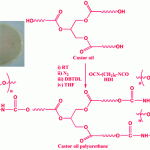
Researchers from Brazil performed an experiment to evaluate the feasibility of OSB Castor oilpanel production Parica (Schizolobium amazonicum) wood particles bonded by castor oil based polyurethane resin. Three different resin contents (8%, 10% and 12%) were evaluated.

Results showed that panels produced with 8% of resin content were best as they were compatible with norm requirements and used less resin in the manufacturing process. Thus Parica wood and castor oil based polyurethane resin in the OSB panels production is feasible.
Source

Electroactive Polyurethane/Siloxane Derived From Castor Oil as a Versatile Cardiac Patch

Scientists from Italy conducted an experiment to synthesize electroactive polyurethane/siloxane films from castor oil for use as a cardiac patch. The electroactive films containing aniline tetramer were prepared through sol gel reaction of trimetcastor oil polyurethanehoxysilane functional intermediate polyurethane prepolymers obtained from castor oil and polyethylene glycol.

Physicochemical, mechanical and electrical conductivity of samples were evaluated and correlated with their structural characteristics. Results showed that the prepared films were compatible with proliferation of C2C12 and had the potential to enhance myotube formation even without electrical stimulation.

Source

Toughening of Poly(L-Lactide) by Polyester-Urethane Networks Based on Castor Oil-Modified Ɛ-Caprolactone Oligomers

Scientists from Japan conducted an experiment to increase the toughness of poly(L-lactide) (PLLA) with the help of polyester urethane networks obtained from castor oil based oligomers.  Hydroxy-terminated castor oil-modified ɛ-castor oilcaprolactone oligomers (CO-CLOns) were prepared by ring opening polymerizations of ɛ-caprolactone initiated with castor oil. It was then allowed to react with poly(L-lactide) which produced semi-interpenetrating polymer networks composed of TDI-bridged CO-CLOn networksand PLLA.
DSC analysis revealed that TCO-CLO10/PLLA 75/25 exhibited the highest tensile toughness compared to other polymer networks.

More

Synthesis and Characterization of Castor Oil-based Polyurethane for Potential Application as Host in Polymer Electrolytes

Researchers from Malaysia conducted an experiment to synthesize castor oil based polyurethane and analyse its potential application as a base material in polymer castor oil polyurethaneelectrolytes. Castor oil polyols were synthesized and mixed with 4,4′-diphenylmethane diisocyanate to synthesize the desired biobased polyurethane.

Characteristic studies showed that the synthesized polyurethane had favourable properties and hence could be used as a base material in polymer electrolytes.

Source

Newly Synthesized Bolaamphiphiles from Castor Oil and their Aggregated Morphologies for Potential Use in Drug Delivery

Researchers from Israel performed an experiment to synthesize bolaamphiphiles frombolaamphiphilic cpds castor oil to be used as potential drug delivery systems. Two classes of symmetric and asymmetric bolaamphiphiles with acetyl choline head groups were synthesized and characterized.

Results showed that these compounds self-assembled in aqueous media to form stable cationic nano-sized vesicles which can used as potential drug delivery systems.

Source

Novel Zwitterionic Surfactant Derived from Castor Oil and its Performance Evaluation for Oil Recovery

Researchers from China performed an experiment to prepare a novel zwitterionic surfactant from castor oil. The novel zwitterionic surfactant was prepared uCastor oilsing a high yield route and its performance for oil recovery was analyzed.

Experimental results showed that the biobased surfactant exhibited strong electrolyte tolerance, temperature resistance, and thermo stability, better wetting and foaming performance, which implies that biobased surfactants could be of great potential to replace traditional petroleum based surfactants.

Source

Epoxidation and Polymerization of Acrylated Castor Oil

Scientists from Turkey conducted a study to investigate a new type of bifunctional Castor oilmonomer obtained from castor oil. Castor oil was first reacted with acryloyl chloride to obtain acrylated castor oil. Epoxidized acrylated castor oil obtained after epoxidation reaction was characterized using various techniques.

After characterization, homo and block copolymers were synthesized and evaluated. It was observed that epoxidized acrylated castor oil copolymer showed higher storage modulus and higher thermal stability.

More

Effect of Castor Oil as an Auxiliary Stabilizer in the Production of Flexible Polyurethane Foams

Researchers from Nigeria performed an experiment to castor oil polyurethaneanalyze the effect of castor oil as an auxiliary stabilizer in the production of polyurethane foams.  Castor oil was used as a substitute to silicone oil at different percentages.

The results showed that castor oil could be a best partial substitute for silicone oil at higher densities.

Source

Blending and Optimization Study on Improved Low-temperature Properties of Chemically Modified High Free Fatty Acid Castor Oil–methyl esters

Researchers from India conducted an optimization study to improve low-temperature properties of chemically modified high free fatty acid castor oil methyl esters. Castor Castor oiloil fatty acid methyl ester was prepared and epoxidation process was carried out using hydrogen peroxide as oxygen donor and IR-120 as heterogenous acid catalyst.

Response surface methodology was implemented to optimize the epoxidation process. The results showed that epoxide blended with COFAME showed an improved pour point compared with pure epoxide.

Source

Preparation of Functionalized Castor Oil Derivatives with Tunable Physical Properties Using Heterogeneous Acid and Base Catalysts

Scientists from India conducted an experiment to prepare functionalized castor oil derivatives with tunable physical properties by using heterogeneous acid and base catalysts. Epoxidized castor oil (ECO) was used as a raw material to prepCastor oilare the different functionalized castor oil derivatives namely ring-opened glyceryl ricinoleates, epoxy alkyl ricinoleates, and ring-opened alkyl ricinoleates, using two chemical reactions, ring opening and transesterification.

Among several acid catalysts screened, Amberlyst 15 showed maximum conversion for ring opening of ECO with methanol. By using CaAl-layered double hydroxide (LDH) derived oxides as base catalyst, maximum yield of epoxy alkyl ricinoleates were obtained through transesterification of ECO. The physical properties of these derivatives can be used to design tailor-make material for industrial needs.

More