Pure Polyurethane and Castor Oil Based Polyurethane: Synthesis and Characterization

Scientists from Malaysia performed an experiment to compare the physico-chemical properties of high performance polyurethane prepared using pure poly propylene glycol (PPG) and that prepared from PPG and castor oil.castor oil polyurethane
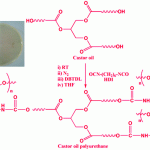
Characterization studies indicated the presence of large -CH stretching in castor oil mixed polyurethane with larger oxidative thermal stability over pure PPG polyurethane. The tensile properties were found to be almost comparable showing that mixed polymers can be used in future to overcome environmental and economic crisis.

Source

Kinetic Modelling of Enzymatic Biodiesel Production from Castor Oil: Temperature Dependence of the Ping Pong Parameters

Scientists performed an experiment to understand the kinetics of transesterification of castor oil using Novozym 235. The genetic algorithm was employed for estimation of kinetic parameters in the Ping Pong kinetic model for castor oil biodieseldifferent temperatures.

Results showed that an acceptable agreement with experimental data was observed when biodiesel yields were predicted using temperature dependent parameters.

Source

Chinese Scientists to Transform Castor Oil into Jet Fuel

Researchers from China have announced the possibility of making jet fuel from castor oil castor oiland are aiming to produce tens of thousands of tons next year.

The team has made one ton of fuel with less than 1.3 tons of castor oil at a cost of less than $23,400. Their research results have been published in the International Journal Bio resource Technology.

Source

Synthesis and Characterization of Castor Oil Based Hybrid Polymers and Their Polyurethane-Urea/Silica Coatings

Scientists performed an experiment to synthesize castor oil based hybrid polymers castor oil polyurethaneand their polyurethane urea-silica coatings. New acrylated alkoxysilane castor oil (AASCO) with hydrolysable –Si–OCH3 was synthesized from CO, maleic anhydride and 3-(Trimethoxysilyl) propyl methacrylate via free radical copolymerization method.

Characterization studies showed that castor oil modified silane based hybrid coatings had better mechanical, viscoelastic properties.

More

In-Situ Epoxidation of Castor Oil Using Heterogeneous Acidic Ion-Exchange Resin Catalyst (IR-120) for Bio-Lubricant Application

Scientists from India conducted an experiment to prepare castor oil epoxide using castor oilheterogeneous acidic ion-exchange resin catalyst (IR-120) for biolubricant application. Epoxidation reaction was carried out at 60°C using IR-120 as a catalyst, acetic acid as an oxygen carrier and hydrogen peroxide as an oxygen donor.

Characterization analysis showed that castor oil epoxide could be used as a potential biolubricant basestock in hydraulic lubricant application.

Source

Production of Oriented Strand Board (OSB) with Schizolobium amazonicum and Castor Oil Based Polyurethane Resin

Researchers from Brazil performed an experiment to evaluate the feasibility of OSB Castor oilpanel production Parica (Schizolobium amazonicum) wood particles bonded by castor oil based polyurethane resin. Three different resin contents (8%, 10% and 12%) were evaluated.

Results showed that panels produced with 8% of resin content were best as they were compatible with norm requirements and used less resin in the manufacturing process. Thus Parica wood and castor oil based polyurethane resin in the OSB panels production is feasible.

Source

Electroactive Polyurethane/Siloxane Derived From Castor Oil as a Versatile Cardiac Patch

Scientists from Italy conducted an experiment to synthesize electroactive polyurethane/siloxane films from castor oil for use as a cardiac patch. The electroactive films containing aniline tetramer were prepared through sol gel reaction of trimetcastor oil polyurethanehoxysilane functional intermediate polyurethane prepolymers obtained from castor oil and polyethylene glycol.

Physicochemical, mechanical and electrical conductivity of samples were evaluated and correlated with their structural characteristics. Results showed that the prepared films were compatible with proliferation of C2C12 and had the potential to enhance myotube formation even without electrical stimulation.

Source

Cadmium Sulfide Quantum Dots Stabilized by Castor Oil and Ricinoleic Acid

Researchers from Tanzania conducted an experiment to stabilize cadmium sulphide quantum dots with the help of castor oil and ricinoleic acid.  Cadmium sulphide quantum cadmium sulphide quantum dotsdots capped with castor oil and ricinoleic acid were prepared and analysed using various characterization techniques.

Results from all the characterization studies confirmed the formation of spherical shaped castor oil and ricinoleic acid capped cadmium sulphide quantum dots.

More

Toughening of Poly(L-Lactide) by Polyester-Urethane Networks Based on Castor Oil-Modified Ɛ-Caprolactone Oligomers

Scientists from Japan conducted an experiment to increase the toughness of poly(L-lactide) (PLLA) with the help of polyester urethane networks obtained from castor oil based oligomers.  Hydroxy-terminated castor oil-modified ɛ-castor oilcaprolactone oligomers (CO-CLOns) were prepared by ring opening polymerizations of ɛ-caprolactone initiated with castor oil. It was then allowed to react with poly(L-lactide) which produced semi-interpenetrating polymer networks composed of TDI-bridged CO-CLOn networksand PLLA.

DSC analysis revealed that TCO-CLO10/PLLA 75/25 exhibited the highest tensile toughness compared to other polymer networks.

More

Fulgar Develops Castor Oil-Based Fibre

Italian synthetic fibre business Fulgar has launched a new high performance nylon fibreFulgar made from biopolymer extracted from castor oil seed.

The fibre, Evo, is suitable for all applications, particularly, for the sports sector as it is ultra-light, stretchy and easily breathable.

Source