Catalytic Pyrolysis of Castor Seed into Liquid Hydrocarbon Transportation Fuels

Scientists performed an experiment to analyze the effect of catalysis pyrolysis ofCastor seeds castor seed on the yield of oil. Catalytic pyrolysis was carried out at 400°C for different ratios of catalyst to biomass using zeolite as catalyst.
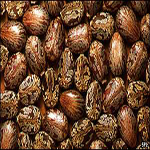
Results showed that compared to thermal pyrolysis of castor seed, catalytic pyrolysis decreased the yield of oil and that the bio oil contained compounds with carbon chain length in the range of C4-C24 that is similar to most of the fuels used.
Source

Novel Zwitterionic Surfactant Derived from Castor Oil and its Performance Evaluation for Oil Recovery

Researchers from China performed an experiment to prepare a novel zwitterionic surfactant from castor oil. The novel zwitterionic surfactant was prepared uCastor oilsing a high yield route and its performance for oil recovery was analyzed.
Experimental results showed that the biobased surfactant exhibited strong electrolyte tolerance, temperature resistance, and thermo stability, better wetting and foaming performance, which implies that biobased surfactants could be of great potential to replace traditional petroleum based surfactants.

Source

Epoxidation and Polymerization of Acrylated Castor Oil

Scientists from Turkey conducted a study to investigate a new type of bifunctional Castor oilmonomer obtained from castor oil. Castor oil was first reacted with acryloyl chloride to obtain acrylated castor oil. Epoxidized acrylated castor oil obtained after epoxidation reaction was characterized using various techniques.
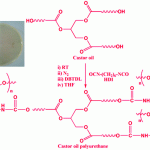
After characterization, homo and block copolymers were synthesized and evaluated. It was observed that epoxidized acrylated castor oil copolymer showed higher storage modulus and higher thermal stability.

More

Effect of Castor Oil as an Auxiliary Stabilizer in the Production of Flexible Polyurethane Foams

Researchers from Nigeria performed an experiment to castor oil polyurethaneanalyze the effect of castor oil as an auxiliary stabilizer in the production of polyurethane foams.  Castor oil was used as a substitute to silicone oil at different percentages.
The results showed that castor oil could be a best partial substitute for silicone oil at higher densities.

Source

Tribological Properties of the Castor Oil affected by the Additive of the Ionic Liquid [HMIM]BF4

Scientists from China conducted an experiment to investigate the influence of ionic liquid [HMIM]BF4  as an additive on the tribologicaal properties of castor oil. The experiment was done by using a four-ball friction test rig.

Castor oil

The results showed that a small amount of ionic liquid can postpone the peak coefficient of friction and decrease the wear behaviour. In addition, the chemical adsorption of castor oil and ionic liquid on a steel surface is more significant than physical adsorption. Thus, the study could be of great importance to understand the potential engineering application of castor oil.

Source

Synthesis of Bio-Castor Oil Polyurethane Flexible Foams and the Influence of Biotic Component on their Performance

Scientists from China conducted an experiment to synthesize bio-castor oil polyurethane flexible foams and study the influence of biotic component on their performance. A series of biobased polyurethane foams were synthesized bCastor oil polyurethaney substituting polyether polyol with castor oil and polyethylene glycol (PEG). The influence of castor oil component on the structure and physical properties of polyurethane foams were studied.

Results showed that the Young’s modulus and compression resilience improved with increased content of castor oil. They also exhibited lower water absorption and higher contact angle with increase in content of castor oil.

Source

Studies on Interfacial Tension and Contact Angle of Synthesized Surfactant and Polymeric from Castor Oil for Enhanced Oil Recovery

Researchers from India performed an experiment to study interfacial tension and contact angle of synthesized surfactant and polymeric from castor oil. The polymeric surfactant was synthesized from pre-synthesized sodium methyl ester sulfonateCastor oil (surfactant) and acrylamide for application in chemical enhanced oil recovery.

The synthesized surfactant and polymeric surfactant were used to measure interfacial tension between their aqueous phase and crude oil phase. Contact angles of solid-crude oil-surfactant interface were also measured. Results showed that interfacial tension was lower which is effective for oil recovery.

More

Response Surface Methodology for Optimization of Bio-Lubricant Basestock Synthesis from High Free Fatty Acids Castor Oil

Scientists from India performed an experiment to optimize the synthesis of biolubricCastor oilant basestock from high free fatty acid castor oil via epoxidation reaction. Influence of various process parameters was optimized.  Central composite design (CCD) was used to evaluate the effects of process variables on maximum oxirane oxygen content (OOC).

From the response surface methodology study, it could be concluded that low FFA CO could act as a suitable feedstock for lubricant synthesis with improved physico-chemical properties.

More


Solubility Assessment of Castor (Ricinus communis L) Oil in Supercritical CO2 at Different Temperatures and Pressures under Dynamic Conditions

Scientists from Malaysia performed an experiment to determine the solubility of castor oil by using supercritical carbon dioxide as extractiCastor oilng solvent.  A simple dynamic technique was used to obtain the solubility of castor oil in super critical carbon dioxide.  Five semi-empirical models were tested for their ability to correlate the experimental data.

Results showed that the test models used correlated the castor oil solubility data with the lowest average absolute relative deviation percentage (AARD %).

More

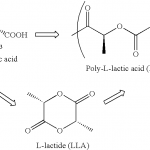
Bio-Based Branched Polymer Bearing Castor Oil Core as a Nucleating Agent for Poly(L -Lactic Acid)

Researchers from Japan performed an experiment to analyze the change in characteristics of PLLA by introducing a biobased branched polymer bearing castor oil core as a nucleating agent.  The Biobased polymer bearing castor oiPoly l-lactic acidl core was synthesized. The nucleating effect of the branched polymer on the crystallization of PLLA was analyzed using differential scanning calorimetry and a polarized optical microscopy.

Results showed that by the addition of the branched polymer, the spherulite size of PLLA became smaller and the strain at break of PLLA containing the branched polymer was improved.

Source