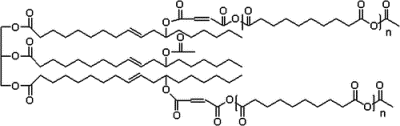
Researchers from the Indian Institute of Science, Bangalore, India, have synthesised a
family of high molecular weight castor oil based biodegradable polyanhydrides by a catalyst-free melt-condensation reaction between prepolymers of castor oil and sebacic acid. Sebacic acid is found to increase the crystallinity of the polymer. Water wettability and ductility decreased while strength of the polymer sharply increased with increase in SA content. Invitro hydrolytic degradation studies indicated surface-eroding behaviour. The degradation products also found to have minimal cytotoxic effects. Thus, a CO-SA polyanhydrides can be characterized for controlled release of drugs, by modulation of physical, mechanical and degradation kinetics.
Category Archives: Castor Oil – Research
Castor Helps Sugarcane Farmers in Erode, Tamilnadu
Sugarcane farmers of Andiyur village in Erode district, Tamilnadu, India use castor solution to trap pests that invades the root system of the crops and the plants. Farmers there face a recurring pest problem called white grub that makes it difficult for them to harvest a good yield. Managing the pest proves difficult for the groundnut cultivators as the grub lives under the soil and its life cycle takes a year to complete. One of the farmers then accidentally got the idea of using castor seeds as an effective trap for the insects.
Some five litre mud pots are buried till the neck at different places in the field, pulverised with about 5kg of castor seed and mixed with five litres of water. The solution was kept undisturbed in a plastic drum for 10 days.
On the 11th day two litres of this liquid is poured in all the buried pots and is filled with water till the neck portion. The odour that comes out from the pot attracts the pest towards it.
In addition to white grub this solution is also found effective to control the notorious rhinoceros beetle that infests coconut trees.
In fact, coconut growers are well aware about the rhino beetle and its damage to fronds and small nuts. This method is a good way of controlling it and does not require a big investment.
The mud pot with the solution needs to be buried near the trunk of the tree and attracted by the odour from the pot the insects come towards it and fall into the pot and die.
Collect the dead insects found floating in the pot once every 2 days and keep filling the pot with solution whenever the quantity gets reduced. The solution can be kept for a period of three months,
Download Free Sample Report on Castor Plant, Castor Oil and Castor Oil Market
Hello Readers,
This blog post briefs some of the highlights of the recently published Comprehensive Castor Oil Report by Castoroil.in.
The Comprehensive Castor Oil Report ( http://www.castoroil.in/reference/report/report.html)is the most detailed report on the castor oil and derivatives industry. Covering every critical aspect of the industry – from cultivation to oil production to the production of diverse oleochemical derivatives – the report has been used by the who’s-who of the global companies investing in castor oil.
The report comprises 255 pages and was last updated in August 2013. The latest update of the report provides more insights and inputs on this exciting industry. Download the free sample report here – http://bit.ly/HJhGKI
The following are the sections for which significant additions are provided in the report:
- Castor Oil and Derivatives Market – The latest updates for the demand supply data for India and worldwide are provided in this version.
- Castor Oil, Castor Seed Prices and Related Commercials – The most recently available data for these are provided.
- Prominent Castor Oil and Derivatives Producers – This section includes profiles and product info for the latest entrants in the markets focusing on producing innovative, high-value end products from castor oil
- Some of the Key Takeaways from the Report :
- The top producers of castor seeds include India, China and Brazil. India is the largest producer of castor seeds with about 80% share, followed by Brazil contributing about 10% and China contributing about 8%.
- The global market for generation II castor oil derivatives and generation III derivatives is estimated at about US$300 million and US$350 respectively.
- Global export of castor oil during 2012 -13 stood at 4,30,752 MT compared to 4,04,489 MT in FY 2011-12.
- Large importers of castor seeds include USA, Netherlands, France, Thailand and Japan. European Union imports over 1,00,000 tonnes of castor oil annually, and almost all its imports are from India.
Castoroil.in welcome the readers to read the sample copy of the report from here — http://bit.ly/HJhGKI and get benefited
Rigid foam polyurethane derived from castor oil for thermal insulation in roof systems
Paper Abstract
This paper discusses the response of the thermal insulation lining of rigid foam polyurethane (PU) derived from castor oil (Ricinus communis) in heat conditions, based on dynamic climate approach. Liners have been widely used, because the coverage of buildings is responsible for the greatest absorption of heat by radiation, but the use of PU foam derived from this vegetable oil is unprecedented and has the advantage of being biodegradable and renewable. The hot wire parallel method provided the thermal conductivity value of the foam. The thermogravimetric analysis enabled the study of the foam decomposition and its lifetime by kinetic evaluation that involves the decomposition process. The PU foam thermal behavior analysis was performed by collecting experimental data of internal surface temperature measured by thermocouples and assessed by representative episode of the climatic fact. The results lead to the conclusion that the PU foam derived from castor oil can be applied to thermal insulation of roof systems and is an environmentally friendly material.
Read the full article here –http://www.sciencedirect.com/science/article/pii/S2095263512000696
Proteome analysis of castor bean seeds
Research Abstract: Castor bean (Ricinus communis L.) seeds serve as raw material for the production of nonedible oil used in medicine and industry, whereas the presence of allergenic and toxic proteins in the residue left after oil extraction precludes the use of this protein-rich by-product in animal feeding. To better understand the enzymes involved in the biosynthesis and degradation of fatty acids and to identify proteins with toxic/anti-nutritional properties, extracts of developing and germinating seeds were prepared and prefractionated according to solubility properties of the proteins. An enriched plastid organelle fraction embracing mostly plastids and mitochondria was also prepared. Two-dimensional electrophoresis (2DE) reference maps of these fractions were obtained from which nearly 400 proteins were identified by matrix-assisted laser desorption ionization-time of flight-time of flight (MALDI-TOF-TOF) mass spectrometry after a search in a National Center for Biotechnology Information (NCBI) database and in an expressed sequence tag (EST) primary bank prepared from a cDNA library of developing seeds. These proteomics techniques resulted in the identification of several classes of seed reserve proteins such as 2S albumins, legumin-like and seed storage proteins, as well as other proteins of plastidial or mitochondrial functions and proteins involved in plant defense against biotic and abiotic stresses. It is expected that the collected data will facilitate the application of genetic techniques to improve the quality/profile of castor seed fatty acids, and pave the way for a rational approach to inactivate allergenic and toxic proteins, allowing the use of castor bean meal in animal feeding.
Read the full article from here – http://pac.iupac.org/publications/pac/pdf/2010/pdf/8201×0259.pdf
Kaiima Seed Tech Company of Israel Gets $65 Million
Kaima seed company of Israel, has received $65 million investment to continue developing its technology for edible wheat, corn, and rice markets,and castor biodiesel.
Investors include the socially conscious Horizons Ventures, managing the private pay-it-forward investments of Li Ka-shing (Horizon previously invested in Facebook and the Israeli startup Waze); the International Financial Corporation, a member of the World Bank Group; and Infinity Group.
Kaiima currently has a commercial product available for castor plants. Read more:
http://www.greenprophet.com/2013/10/israel-kaiima-seed-tech-company-raises-65-million/
Some interesting links
Castor Bean Proteins Mapped;Results Unconvincing For Castor Biodiesel
Danish scientists say a study of one biodiesel source plant — the castor bean — predicts problems if it’s considered for large-scale use as a fuel source.
While countries like Brazil and India grow large quantities of castor oil beans that can be refined into bio-diesel, the beans contain allergens and also the extremely potent poison ricin, meaning bean pulp left after extraction of the oil cannot be used for animal feed and becomes a problematic waste byproduct.
“Therefore we are interested in finding out if it in some way could be possible to eliminate the allergenic proteins and the ricin from the beans, so that the pulp can be used for animal feed,” said biochemist Peter Roepstorff at the University of Southern Denmark.
Roepstorff and a team of Danish/Brazilian colleagues have mapped thousands of proteins found in castor beans, with discouraging results.
While both ricin and the allergen 2S Albumin are only present in low amounts in the early development stages of the bean, they found, as the beans mature the content of ricin and 2S Albumin increases.
“Unfortunately, the mature beans also have the highest oil content and therefore an oil producer will not harvest the beans before they are fully mature,” Roepstorff said. “The price of optimizing the oil production is that you also get a toxic and allergenic pulp that cannot be used for animal feed.”
One option would be to eliminate the unwanted proteins by plant breeding, the researchers said. Another option is to remove them by genetic engineering
Characterization of Blend Properties of Castor Biodiesel and Bioethanol
Some important properties of biodiesel such as viscosity, melting point, thermal stability, and cetane index can be directly related to the chemical composition of the biomass source used. However, the viscosity of castor oil ethyl ester (COEE) is about four times greater than the biodiesel viscosity specification, and this fact restricts the uses of this biofuel. The main goal of this work is to investigate the physical–chemical properties of COEE in ethanol blends and present an option to decrease the castor oil biodiesel viscosity specification. COEE viscosity is 14.413 mm2/s. The results show an evident decrease in biodiesel viscosity with the addition of ethanol. Samples with 30, 40, and 50 vol % of ethanol present the following viscosities 5.316, 4.044, and 3.136 mm2/s, respectively. These results are in agreement with Brazilian National Agency of Petroleum, Natural gas and Biodiesel (ANP), and European (EN 14214) specifications. Three correlations that describe the decrease in viscosity and density with ethanol concentration, and the variation of viscosity with the density in COEE ethanol blends were obtained. The behavior of COEE ethanol blends with diesel also were analyzed. The increase in solubility of ethanol in commercial diesel was verified because COEE acts as a cosolvent in an ethanol–diesel mixture.
Application of Castor Oil-Based Cutting Fluids in Precision Turning
In this study, a new green castor based emulsion has been successfully developed and investigated.
Abstract: Green machining is a process that implements sustainable development strategy. In order to reduce cost and decrease environmental pollution in manufacturing process, a sort of biodegradable castor oil-based emulsion is developed, whose physical and chemical properties can correspond with the national standards. The cooling and lubricating properties of the emulsion are better while machining steel materials through comparative experiments with certain imported commodity synthetic cutting fluid. The emulsion can successfully substitute for commodity fluid because of its high performance-price ratio.
Read more: http://www.scientific.net/AMM.130-134.3830
Development of Oleogels Using Castor Oil Derivatives for Lubricating Greases
This blog post is an abstract of the research work focused on the development of new oleogels, using castor oil and cellulose derivatives, which could be potentially used as biodegradable lubricating greases
Thermal and thermo-rheological behaviours of castor oil and cellulose derivatives were characterised by means of TGA analysis and SAOS measurements, in order to evaluate the evolution of oleogel microstructure with temperature. Moreover, both roll-stability and leakage tendency standard tests, usually performed in the grease industry, were used to evaluate the mechanical resistance of each sample. The evolution of biogrease linear viscoelasticity functions with frequency is quite similar to that found for traditional lithium lubricating greases. However, the influence of temperature on biogreases linear viscoelasticity functions is less important than that found for traditional greases. In general, the biogrease samples studied show both slightly lower mechanical stability and higher leakage tendency than traditional lubricating greases. The use of a blend of ethyl and methyl cellulose as thickener provides a mechanical stability comparable to that found for commercial greases.
Read:http://pubs.rsc.org/en/Content/ArticleLanding/2009/GC/b820547g#!divAbstract
Some interesting links