Inter-Vesicle Polymerization Using Non-ionic Oxyethylene Hydrogenated Castor Oil

Scientists from Japan conducted an experiment to analyze the nature and Castor oilcharacteristics of polymerizable vesicles produced by using oxyethylene hydrogenated castor oil.  Polymerized vesicles were produced in aqueous solution. Hydrogen NMR spectroscopy was used to investigate the polymerization process using azobis(isobutyronitrile) as an initiator.
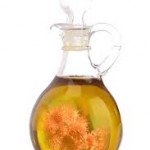
Results showed that the polymerized vesicles were resistant to disruption by polyoxyethylene(10) octylphenyl ether. The degree of resistance depends on vesicle concentration and incubation temperature and this dependence is due to the inter-vesicle polymerization.
Source

Thermo-mechanical Analysis of Foam Based on Castor Oil Polyol

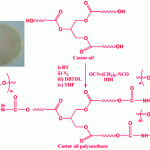
Researchers from India conducted an experiment to analyze the thermo-mechanical properties of castor oil based polyol foam. Castor oil was extracted usicastor oil polyurethaneng hydraulic press and was allowed to react with toluene diisocyanate and other material to obtain the polyurethane foam. Incorporation of castor oil increased the hardness, density and compression of the foam. The cost of production also significantly decreased.
These results suggest that castor oil could be widely used for the manufacture of polyurethane foam.

Source

Transesterification of Castor Oil with Methanol – Kinetic Modelling

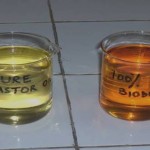
Scientists from India conducted an experiment to determine the kinetcastor oil biodieselics of the production of biodiesel. Transesterification of castor oil was carried out with methanol and sulphuric acid as catalyst under different temperature conditions.

The obtained results were analyzed with respect to three types of reaction kinetics and it was concluded that the experimental data followed second-order reversible reaction kinetics.

Source

Characterization of Novel Castor Oil-Based Polyurethane Polymer Electrolytes

Researchers from Malaysia conducted an experiment to analyCastor oil polyurethaneze the application of castor oil based polyurethane as a host in polymer electrolyte for electrochemical devices. The synthesized castor oil polyurethane was added with lithium iodide and sodium iodide in different wt% to form a film of polymer electrolytes.

The results showed that castor oil based polyurethane polymer electrolytes can be used  as an alternative membrane for electrochemical devices.

Source

Synthesis of Biodiesel from Castor Oil: Silent versus Sonicated Methylation and Energy Studies

Researchers from Spain conducted an experiment to compare conventional ancastor oil biodieseld ultrasound-assisted transesterification for the production of biodiesel from castoroil. The results showed that sonicated transesterification leads to higher castoroil methyl ester yield.

The energy required along each type of transesterification was measured which showed that sonicated transesterification consumes lower amount of energy than conventional one.

Source

Effect of Castor Oil/Polycaprolactone Hybrid Polyols on the Properties of Biopolyurethane

Scientists from Korea have conducted an experiment to test the effects of castor oil/ polycaprolactone hybrid polyols on the properties of biopolyurethane. Organic solvent soluble castor oil/polycaprolactone diol (PCL) based polyurethane was prepared.Polycaprolactone

The results showed that the tensile properties and shape memory of castor oil/PCL based polyurethane were enhanced when compared with PCL based polyurethane. The enhancement in properties was due to the increased hard segment portion and cross linking density by 3 urethane bonds formed per molecule in the castor oil/PCL mixed system.

This research suggests that castor oil/ PCL based polyurethane could be used as biobased coating materials.

More

Synthesis and Characterization of Acrylated Epoxidized Castor Oil Nanocomposites

Scientists from India synthesized a renewable resource based epoxidized castorCastor plant oil (ECO) and used it as a prime material to develop acrylated epoxidized castor oil (AECO) networks. AECO nanocomposites were prepared by sol-gel method using OMMT clay and silane.

The results showed that AECO/1 wt.% OMMT system increases in tensile strength from 28 to 37 MPa and flexural strength from 54 to 63 MPa as compared with the AECO system, respectively.

Source

High Yield Castor Varieties in India

While India currently average about 1 T/hectare per year for castor seeds, there is potential for much higher yield.

As part of the research to increase yields, efforts have been going on in India for high yielding varieties of castor.

The table below shows the various high yielding castor varieties produced by different states across India.

State Variety Hybrid
Andhra Pradesh Aruna, Bhagya, Sowbhagya, Kranti (PCS-4), Jwala, DCS-9
(Jyothi), Kiran (PCS-136), Haritha (PCS-124).
Uttar Pradesh Kalpi-6, T-3, T-4
Gujarat GAUC-1, VI-9, S-20, J-1andGCH 7 CH-1, GCH-2, GCH-3, GCH6, SHB-145, GCH-7 and(SKP 84 x SKI 215
Tamil Nadu TMV-1, TMV-2, TMV-3, TMV-5, SA-1, SA-2, TMV-4,Jyothi, CO-1 TMVCH-1and TMVCG*
Karnataka Jwala (48-1), RC-8, Jyothi
Maharashtra AKC-1, Girija GCH-6
Rajasthan GCH-6, RHC-1
Haryana CH-1
Punjab Pb. No.1
For all states Gujarat Castor-2 DCH-32 (Deepti)DCH-177 (Deepak)GCH-4, GCH-5, DCH 519
For entire country DCH 519 M 574 x DCS 78

Current Applications of Castor Oil & Derivatives

Castor has one of the most diverse set of applications among all plant oils.

This post reviews and summarises the key current applications of castor oil and derivatives. Another post of mine looks at emerging applications of castor oil derivatives.

The current applications of prominent castor oil derivatives.

Blown Castor Oil Potential replacement for phthalates, used primarily as a plasticizer for lacquers, inks, adhesives, hydraulic fluids and leathers.
Sulfated/Sulfonated Castor Oil Synthetic detergent, used in bath oil recipes along with fragrance or essential oils, or in shampoos, used in agriculture as organic manure
Hydrogenated Castor Oil Used in polishes, cosmetics, electrical capacitors, carbon paper, lubrication, and coatings and greases, use in cosmetics, hair dressing, ointments
Sebacic Acid Sebacic acid and hexamethylene diisocyanate produce Nylon 6-10, used as an intermediate for aromatics, antiseptics and painting materials
Ricinoleic Acid Uses include, coatings, plastics, inks and cosmetics, Ricinoleate soaps have been patented as algaecides for aquaculture systems.
2-Octanol(Capryl alcohol) Main raw material for some esters, used as a solvent, dehydrater and antibubbling agent,  used as fiber oil
Castor Seed Residue, also called Castor Meal Fertilizer and as fuel
12-Hydroxy Stearic Acid (12-HSA) Used in grease manufacture, plastics lubrication.
Dehydrated Castor Oil (DCO) Used to improve the quality of house paints, enamels, caulks, sealants and inks. It is used as primary binder for house paints, enamels, caulk sealant, and making varnishes

Castor Oil and castor Oil Derivatives Production in India

This post provides details of castor oil and castor derivatives production in India.

Castor Oil Production

The castor oil production in India was 0.55 million tons in the year 2011-12 and 0.56 lakh tons in 2012-13.

Country 2011-12(million tons) % of world total 2012-13(lakh tons) % of world total
India 0.55 79% 0.56 82%

Castor Derivatives Production

The production range of various castor oil derivatives is given in the following table expressed in tons/annum (TPA).

 Castor Oil Derivative Name Installed Capacity TPA
Hydrogenated Castor oil 50,000
12-Hydroxy Stearic Acid 30,000
Dehydrated Castor Oil 17,500
Ricinoleic Acid (RA) and Methyl Ricinoleic Acid 6,500
Blown Castor oil (SCO) 2,500
Sebacic Acid 10,500
Undecylenic Acid and their Salts 2,500
Heptaldehyde 1,500
Ethoxylated Castor oil 3,000